
Chief Operating Officer (Chief OO): A Strategic Guide for UK Business Leaders
Updated: Mar 20
What if the biggest threat to your scale-up's future isn't the market, but the 60-hour work week you're currently enduring to keep things running? As a UK business leader, you're the visionary and the strategist, but you're also likely the chief firefighter. We understand that juggling high-level goals while being pulled into every operational snag is a direct route to burnout, creating a frustrating gap between your ambition and your company's actual performance.
This guide is designed to bridge that gap. We will demystify the role of the strategic operator, the chief oo, and demonstrate how this position transforms ambitious plans into tangible, day-to-day reality. You'll gain a clear framework for turning operational chaos into a streamlined, scalable engine for sustainable growth. Together, we'll explore the core responsibilities of a COO, assess precisely when your business is ready for one, and help you navigate the critical decision between hiring a full-time executive, engaging a fractional leader, or leveraging strategic HR support.
Key Takeaways
Understand the essential "Visionary vs. Integrator" dynamic between a CEO and a chief oo to ensure your company's strategy is effectively translated into daily operations.
Pinpoint the critical growth stages and warning signs—like the "founder trap"—that indicate your UK SME is ready for dedicated operational leadership.
Discover how fractional leadership offers a flexible, high-impact alternative to a full-time executive hire, providing strategic expertise without the significant overhead.
Learn the frameworks required to shift your business from a reactive "firefighting" mode to a proactive, future-proof operational model built for sustainable scaling.
Table of Contents What is a Chief OO? Defining the Role in the 2026 UK Business Landscape CEO vs. Chief OO: Navigating the Most Critical Partnership in Your Business Do You Really Need a Chief OO? Identifying the Tipping Point for UK SMEs The Rise of Fractional Leadership: Operations Meets People Strategy in the South East Scaling Your Business with Pioneer HR’s Strategic Operational Support
What is a Chief OO? Defining the Role in the 2026 UK Business Landscape
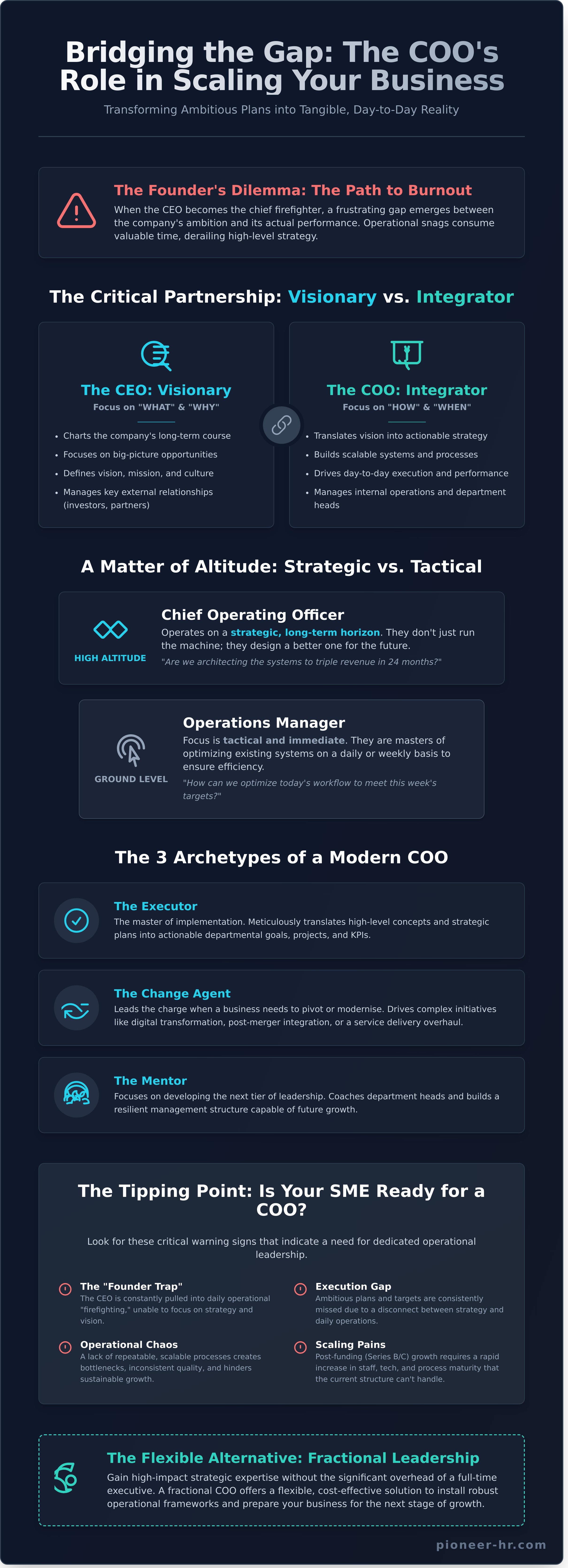
In the executive suite of any ambitious UK business, the Chief Operating Officer (Chief OO) serves as the essential "Second in Command." This role is the strategic linchpin between the CEO's vision and the company's day-to-day reality. While the traditional answer to What is a Chief Operating Officer? often conjures images of a seasoned executive within a FTSE 100 giant, the role has undergone a profound evolution. Today, particularly within London's dynamic tech and service sectors, the COO is less of a corporate heavyweight and more of an agile organisational architect, essential for navigating rapid growth.
This shift is driven by necessity. Since 2022, we've observed a clear trend: UK-based Series B and C funded companies have increased their hiring for this position as they recognise the critical need for operational excellence to sustain their trajectory. The core mission of a modern chief oo is no longer just about managing existing operations; it's about turning abstract strategy into the repeatable, scalable, and profitable processes that define a market leader. They build the engine while the CEO steers the ship.
The Key Archetypes of a Modern Chief OO
The COO role isn't monolithic; it adapts to the specific needs of the business at a particular point in its journey. We find that the most effective COOs in the UK market often embody one of three primary archetypes:
The Executor: This COO is the master of implementation. They take the CEO’s high-level concepts and strategic plans and meticulously translate them into actionable departmental goals, projects, and KPIs, ensuring the vision becomes a tangible reality.
The Change Agent: When a business needs to pivot or modernise, this COO leads the charge. They are specialists in driving complex initiatives like digital transformation, post-merger integration, or a complete overhaul of the company's service delivery model.
The Mentor: In organisations with strong succession planning, the COO often takes on a mentorship role. They focus on developing the next tier of leadership, coaching department heads, and building a resilient management structure capable of future growth.
Chief OO vs. Operations Manager: Knowing the Difference
A frequent point of confusion for business leaders is distinguishing between a COO and an Operations Manager. The difference lies in strategic altitude. An Operations Manager’s focus is tactical; they are masters of optimising existing systems on a daily or weekly basis to ensure efficiency and meet current targets. Their world is the here and now.
The Chief Operating Officer, in contrast, operates on a strategic, long-term horizon. They aren't just running the machine; they are designing a better one for the future. In a UK scale-up, the Chief OO’s strategic scope is to design and implement the operational infrastructure that enables the business to triple its revenue over 24 months without sacrificing quality or culture.
Consequently, their influence on the bottom line extends far beyond simple cost-cutting. A skilled COO drives profitability by architecting systems that enhance customer lifetime value, creating operational capacity that allows the sales team to close more deals, and building a scalable framework that prevents the all-too-common stalls in growth that plague ambitious SMEs. They are the architects of sustainable profit, not just the guardians of expense lines.
CEO vs. Chief OO: Navigating the Most Critical Partnership in Your Business
In any successful UK business, the relationship between the Chief Executive Officer and the Chief Operating Officer is the engine room of execution. It's a dynamic often described as the "Visionary" and the "Integrator." The CEO charts the course, focusing on the "what" and "why," while the COO builds the high-performance machine to get there, mastering the "how" and "when." One without the other results in either a brilliant strategy with no execution or flawless operations with no direction. They are two sides of the same leadership coin.
This synergy is particularly vital in London’s fast-paced SME environment, where companies must scale rapidly to survive. A CEO might secure a £5 million Series A funding round based on a compelling vision, but it's the chief oo who must translate that capital into tangible growth by hiring 50 new staff, optimising the tech stack, and ensuring the supply chain can handle a 300% increase in demand. According to the Institute of Directors, a well-defined CEO vs. COO partnership is a hallmark of high-growth firms. Yet, friction is common. Disagreements over autonomy, breakdowns in communication, and blurred lines over responsibilities can cripple an organisation. The antidote is a shared, objective view of the business: a "Single Source of Truth" for performance and reporting that aligns both leaders on facts, not feelings.
This dynamic isn't limited to venture-backed tech. Consider a successful niche e-commerce business, such as a specialist model railway supplier like narrowmindedrailworks.com. The founder's vision creates demand, but it's the operational leader who must manage the intricate supply chain, inventory, and fulfillment to keep customers happy and the business growing.
This principle holds true across vastly different industries. For instance, a real estate investment firm like Peregrine REI, which operates in the fast-paced US market, is built on operational excellence. While the CEO's vision might focus on market expansion, the COO's role is to ensure that every step—from initial homeowner contact to closing the sale—is executed flawlessly and efficiently. This operational backbone is what allows the business to scale successfully, demonstrating that the Visionary/Integrator dynamic is universal.
This principle extends even to highly specialized, craft-based industries. A business that creates custom interior fireplaces, for example, must perfectly integrate an artistic vision with the complex logistics of safe construction and installation. A company like hrejicikrby.cz showcases projects where the initial concept (the CEO's 'what') and the masterful execution (the COO's 'how') must align perfectly, proving the universal need for both visionary and integrator roles.
Division of Labour: Who Owns What?
A clear demarcation of responsibilities prevents leaders from stepping on each other's toes. While every organisation is unique, a successful split typically assigns external-facing and future-focused duties to the CEO, with internal and present-focused execution falling to the COO.
CEO Focus: External relations with investors and the media, leading fundraising efforts, setting the long-term (3-5 year) vision, and championing the company culture from the top down.
Chief OO Focus: Internal systems and processes, managing the supply chain, overseeing day-to-day delivery, and owning the operational and financial performance metrics (KPIs).
For instance, a Sussex-based leadership team we worked with created a shared dashboard. The CEO’s view prioritised market share and investor updates, while the COO’s view focused on production uptime and employee productivity. Both leaders saw the same core financial data, ensuring they were always working from a unified playbook.
The Trust Factor: Communication Strategies for Success
Structure alone isn't enough; trust is the glue that holds this partnership together. This trust is built and maintained through disciplined communication. The most effective leadership duos operate a strict "no-surprises" policy, where significant operational challenges or strategic shifts are discussed directly and immediately. This prevents the CEO from being blindsided in a board meeting or the COO from learning about a pivot through a company-wide email.
Regular, structured operational audits are another powerful tool for preventing misalignment. These reviews go beyond financial reports to assess the health of the systems, processes, and people that drive the business. A comprehensive HR Audit, for example, can provide objective data on team structure, performance bottlenecks, and flight risks, giving both leaders the clarity needed to make proactive decisions. By grounding conversations in impartial data, you can ensure your leadership team remains strategically aligned. Properly structuring your C-suite roles is one of the most impactful investments you can make in your company's future.
Do You Really Need a Chief OO? Identifying the Tipping Point for UK SMEs
For many ambitious UK business leaders, the question isn't if they will need senior operational leadership, but when. Whether you're running a fast-growing tech firm in Hove or a scaling manufacturing business in Kent, there comes a point where the very systems that sparked your initial success begin to hinder future growth. This is often where the "Founder Trap" snaps shut: the CEO, once the driving force of innovation, becomes the bottleneck for every operational decision, from signing off purchase orders to managing inter-departmental conflicts.
This pressure isn't just structural; it's deeply personal. For leaders facing this challenge, coaching that focuses on the individual behind the executive title is essential for navigating the stress. While based in the Netherlands, the approach of coaching specialists like Inner Ik offers valuable insights for any entrepreneur on developing the personal resilience and clarity needed to lead effectively through periods of intense growth.
The transition from a lean start-up to a structured SME is fraught with operational challenges. Recognising this tipping point is the first step toward building a sustainable, scalable enterprise. The decision to hire a chief oo is not a sign of failure; it’s a hallmark of strategic maturity.
The 5 Signs You Need Operational Leadership Now
Growth often exposes the cracks in your operational foundation. If you recognise several of the following symptoms, the time for a dedicated operational leader has likely already arrived.
Customer satisfaction is dropping. Your sales team is hitting targets, but your Trustpilot score is falling. As order volume increases by 25%, you notice customer complaints about delivery times or service quality have risen by 40%. This signals that your processes can't handle the scale.
The CEO spends 80% of their time on "firefighting". The leader's calendar is consumed by internal issues, supply chain problems, and HR disputes instead of strategy, fundraising, or high-level partnerships. This is a critical misallocation of your most valuable asset.
Key employees are leaving. You're losing talented staff who cite burnout, lack of clear processes, or frustration with organisational chaos as their reasons for leaving. With the cost of replacing a single employee estimated by Oxford Economics to be as high as £30,000, high turnover is a direct blow to your bottom line.
Profit margins are shrinking despite revenue growth. Top-line revenue looks healthy, but profitability is flat or declining. This points directly to hidden inefficiencies, wasted resources, or a lack of scalable systems that a COO is specifically trained to identify and rectify.
Projects stall between departments. A new product launch or system implementation grinds to a halt because marketing, sales, and operations aren't aligned. Without a single owner of cross-functional execution, internal silos form and momentum is lost.
The Cost-Benefit Analysis of the Chief OO Role
The most common objection we hear is, "We aren’t big enough for a COO yet." This perspective often focuses solely on salary cost while ignoring the far greater cost of operational inefficiency. Let's reframe the conversation around return on investment.
Consider a UK SME with a £5 million turnover. A COO who implements process improvements that create just a 5% efficiency gain adds £250,000 in value. If they also reduce staff turnover by 15%, preventing the loss of just two key team members, that could save another £60,000 in recruitment and training costs. These figures quickly eclipse the investment in their compensation. To get a realistic view of executive pay, our 2026 Salary Benchmarking report provides precise data for top-tier operational leaders in the UK.
Ultimately, the most profound value lies in a simple transaction: buying back the CEO’s time. If a founder can shift 20 hours per week from reactive problem-solving to proactive, high-value strategic work, the impact on the company’s trajectory is immeasurable. That is the real ROI of an effective operational leader.
The Rise of Fractional Leadership: Operations Meets People Strategy in the South East
For ambitious scale-ups across London and Kent, the decision to hire a full-time C-suite executive is a significant gamble. A permanent Chief Operating Officer comes with a hefty price tag, often exceeding £185,000 in total annual cost, a substantial commitment for a business still navigating its growth trajectory. This financial risk, coupled with the challenge of finding the perfect long-term fit, is leading many leaders to embrace a more agile and strategic alternative: fractional leadership.
The fractional model provides access to executive-level expertise on a part-time, flexible basis. A seasoned operational leader embeds within your business for one or two days a week, focusing exclusively on high-impact strategic initiatives. The principle is simple: they deliver an estimated 80% of the strategic value for as little as 20% of the full-time cost. For example, securing a top-tier operational strategist for one day a week can cost around £38,000 per year, providing immense leverage without the long-term financial burden of a full-time hire.
Why People Strategy is the Engine of Operations
The most elegant process or system is rendered useless without the right people to execute it with passion and precision. This is where the roles of operations and human resources intersect. A modern chief oo understands that optimising workflows is secondary to empowering the team. True operational excellence is built on a foundation of strong company culture, clear roles, and engaged employees. For smaller businesses, this creates a powerful opportunity. Explore how a Fractional Chief People Officer bridges this exact gap, ensuring your people strategy directly fuels your operational goals.
Similarly, when it comes to managing the financial complexities of scaling, many businesses find immense value in fractional CFO services. For companies needing expert financial advisory and accounting consulting without the full-time overhead, firms like SA Unlimited provide that crucial strategic support.
Local Case Study: Scaling a Sussex Business Without the Overhead
Consider a Brighton-based SaaS firm we partnered with in 2022. They faced a classic scale-up challenge: rapidly increasing demand was straining their internal processes, but the budget for a full-time COO was unavailable. By engaging a fractional operations leader, they gained the strategic oversight needed to re-engineer their delivery model. The results were transformative. Within 12 months, they successfully doubled their headcount from 25 to 50 employees and reduced new hire onboarding time by 40%. This success was underpinned by creating a compelling Reward Strategy to attract and retain the high-calibre operational talent needed to execute the new vision. The fractional model gave them the flexibility to scale support in line with revenue, de-risking their growth during fluctuating UK market conditions.
This agile approach allows businesses to invest in top-tier strategic guidance precisely when it's needed, aligning operational improvements directly with people-centric growth. It’s a smarter way to scale.
Discover how our fractional leadership model can align your operations and people strategy for sustainable growth. Book a consultation with our team today.
Scaling Your Business with Pioneer HR’s Strategic Operational Support
As a CEO, your focus should be on vision, growth, and market leadership. Yet for many leaders of UK SMEs, the reality is a constant battle with operational fires: inefficient workflows, unresolved people issues, and processes that creak under the strain of growth. This is where the gap between ambition and execution widens. It’s the precise point where strategic operational leadership becomes not a luxury, but a necessity for survival and scale.
At Pioneer HR, we partner with ambitious businesses across London, Hove, and the wider UK to bridge that gap. We move you from a reactive state of "firefighting" to a proactive one of "future-proofing." With over 30 years of collective experience navigating the complexities of UK employment law and market dynamics, we provide the seasoned expertise of a high-calibre Chief People Officer and operational leader without the £150k+ annual cost of a full-time executive hire. Our role is to build the robust operational engine that powers your vision.
Our Approach to Fractional Leadership
We believe that effective operational strategy isn't about off-the-shelf solutions; it’s about a deep, collaborative partnership. Our proven three-step process ensures that our support is perfectly aligned with your unique commercial goals.
Step 1: The Deep-Dive Audit. We begin by immersing ourselves in your business. This involves a comprehensive review of your current people infrastructure, operational processes, and technology stack. We analyse everything from employment contracts and performance management systems to inter-departmental workflows to identify critical bottlenecks and opportunities for immediate improvement.
Step 2: Designing a Bespoke Roadmap. Based on the audit, we co-create a strategic roadmap for operational excellence. This isn't a theoretical document; it's a practical, phased plan with clear milestones, KPIs, and resource allocation. It outlines the precise steps needed to build scalable, compliant, and high-performing operations.
Step 3: Hands-On Implementation. We then roll up our sleeves and work alongside your existing team to bring the roadmap to life. Whether it's implementing a new HRIS, refining your onboarding process, or coaching line managers, we provide the hands-on leadership to drive change, ensuring new systems are embedded and adopted effectively.
Take the Next Step Toward Operational Freedom
For many UK SMEs, the temptation is to wait for the "perfect time" to invest in senior operational leadership. This is a costly mistake. Delaying this critical function means you're building future growth on a flawed foundation. According to the Federation of Small Businesses, poor management practices and operational inefficiencies cost the UK economy an estimated £19 billion per year in lost productivity. Waiting to hire a full-time chief oo means this operational debt continues to accumulate, making future scaling slower and more expensive.
Don’t let operational drag hold your vision back. Reclaim your time and empower your team with the strategic support needed to achieve your most ambitious goals. Let’s start a conversation focused not on today's problems, but on where you want your business to be in 2026.
Ready to build a business that can scale with confidence?
Your Next Step in Operational Excellence
The modern UK business landscape demands more than just a vision; it requires flawless execution. The synergy between a CEO and their operational counterpart is the engine of sustainable growth, and for many scaling SMEs, the tipping point for needing a chief oo arrives sooner than expected. However, a full-time hire isn't always the most strategic first step.
This is where strategic, flexible support becomes invaluable. With over 30 years of combined HR and operational experience, we provide specialist support for businesses across London, Hove, and Sussex. Our proven track record in organisational development and salary benchmarking ensures your operational structure is not just efficient, but built for long-term success.
Ready to scale? Discover how our Fractional CPO service supports your operational goals. Let’s build your operational future, together.
Frequently Asked Questions About the Chief OO Role
What is the difference between a COO and a Chief OO?
There is no functional difference between a Chief Operating Officer (COO) and a Chief OO; the terms are used interchangeably. "Chief OO" is a more modern, often informal, abbreviation for the same C-suite role. Both titles refer to the senior executive responsible for overseeing the company's day-to-day administrative and operational functions. The choice of title often comes down to a company's internal culture and branding preferences rather than any distinction in responsibilities.
How much does a Chief Operating Officer cost in the UK in 2026?
A full-time Chief Operating Officer's salary in the UK for 2026 is projected to range from £125,000 to £230,000, excluding bonuses and equity. This forecast is based on 2024 market data from firms like Morgan McKinley, with an anticipated annual salary inflation of 3-4%. The final figure depends heavily on the company's size, industry, and location, with roles in London's financial or tech sectors commanding salaries at the upper end of this scale.
Can a small business with fewer than 20 employees benefit from a Chief OO?
Yes, a small business can gain significant advantages from operational leadership, often through a fractional model. A part-time Chief OO can streamline chaotic processes, implement scalable systems, and free up the founder's time by at least 8-10 hours per week. This allows the CEO to focus on vision and growth. For a small team, this strategic oversight is crucial for navigating growth phases without being overwhelmed by operational bottlenecks.
What is a Fractional Chief Operating Officer, and how does it work?
A Fractional Chief Operating Officer is a senior operational executive who works with a business on a part-time, contract basis. Instead of a full-time hire, a company can secure their expertise for a set number of days per month, typically between two and eight. This model provides access to C-suite talent and strategic guidance for a fraction of the cost of a full-time salary, making it an ideal, flexible solution for SMEs aiming to scale efficiently.
Does a Chief OO manage the HR department?
A Chief OO does not typically manage the HR department directly, but they are a key strategic partner to HR leadership. The COO's role is to ensure that all business operations are efficient and effective, which includes how people are managed. They collaborate closely with the Head of HR or CHRO to align people strategy with operational goals, ensuring that hiring, training, and performance management systems support the company's core objectives and drive productivity.
What qualifications should I look for when hiring a Chief OO in London?
When hiring in London, look for a candidate with at least 10-15 years of progressive leadership experience, ideally within a relevant high-growth sector like FinTech, SaaS, or professional services. A strong academic background, such as an MBA from a top-tier institution like London Business School or Imperial College, is highly desirable. Crucially, they must demonstrate a proven track record of scaling operations, managing P&L, and implementing measurable process improvements in a competitive market.
How long does it take to see results after hiring operational leadership?
You can expect to see initial diagnostic results and 'quick wins' within the first 90 days. During this period, a skilled COO will identify key inefficiencies and begin implementing foundational changes. More substantial, data-driven results, such as a 10-15% improvement in operational efficiency or a measurable reduction in costs, typically become evident within 6 to 12 months as new systems and strategies become fully embedded across the organisation.
What is the first thing a new Chief OO should do in an SME?
The first priority for a new chief oo in an SME is to conduct a thorough 360-degree operational assessment. This involves mapping all key business processes, interviewing department heads and key staff, and analysing performance data from the past 12-24 months. The objective is to create a clear baseline of the company's operational health. This diagnostic phase is critical for identifying the 2-3 most impactful areas for immediate improvement and building a data-backed strategic plan.


Comments