
What Is a Competitive Pay Rate? A Complete Guide for UK Employers
Updated: Feb 28
Have you ever invested significant time and resources into a recruitment process, only to lose your ideal candidate to a competitor at the final hurdle? Or perhaps you're watching valuable team members leave, creating a costly cycle of turnover that impacts both morale and productivity. These are common challenges for UK employers, and they often stem from a single, critical question: what is a competitive pay rate in today's dynamic market?
Getting compensation right is more than just a number on a payslip; it's a strategic cornerstone for sustainable business growth. In this comprehensive guide, we will move beyond the guesswork. We'll explore what 'competitive' truly means in the UK context, provide a clear framework for benchmarking your salaries, and empower you to build a fair and effective pay strategy. Our goal is to give you the confidence to not only attract the high-calibre talent your business deserves but to retain them for the long term.
Key Takeaways
Understand what is competitive pay rate: it's a strategic salary range, not a single figure, benchmarked against current market rates for a specific role and industry.
Discover how defining what is competitive pay rate for your team directly impacts key business outcomes. A strong answer to what is competitive pay rate can boost employee retention, engagement, and overall profitability.
Learn the process for establishing what is competitive pay rate for your roles by following a clear, 4-step salary benchmarking process designed for UK businesses.
Identify and avoid common pitfalls in setting salaries. A key mistake is miscalculating what is competitive pay rate by ignoring regional pay variances or undervaluing non-monetary benefits.
Table of Contents Defining Competitive Pay: More Than Just a Number Why Offering a Competitive Pay Rate is a Business Imperative How to Determine a Competitive Pay Rate: A 4-Step Process Common Pitfalls to Avoid When Setting Pay Rates
Defining Competitive Pay: More Than Just a Number
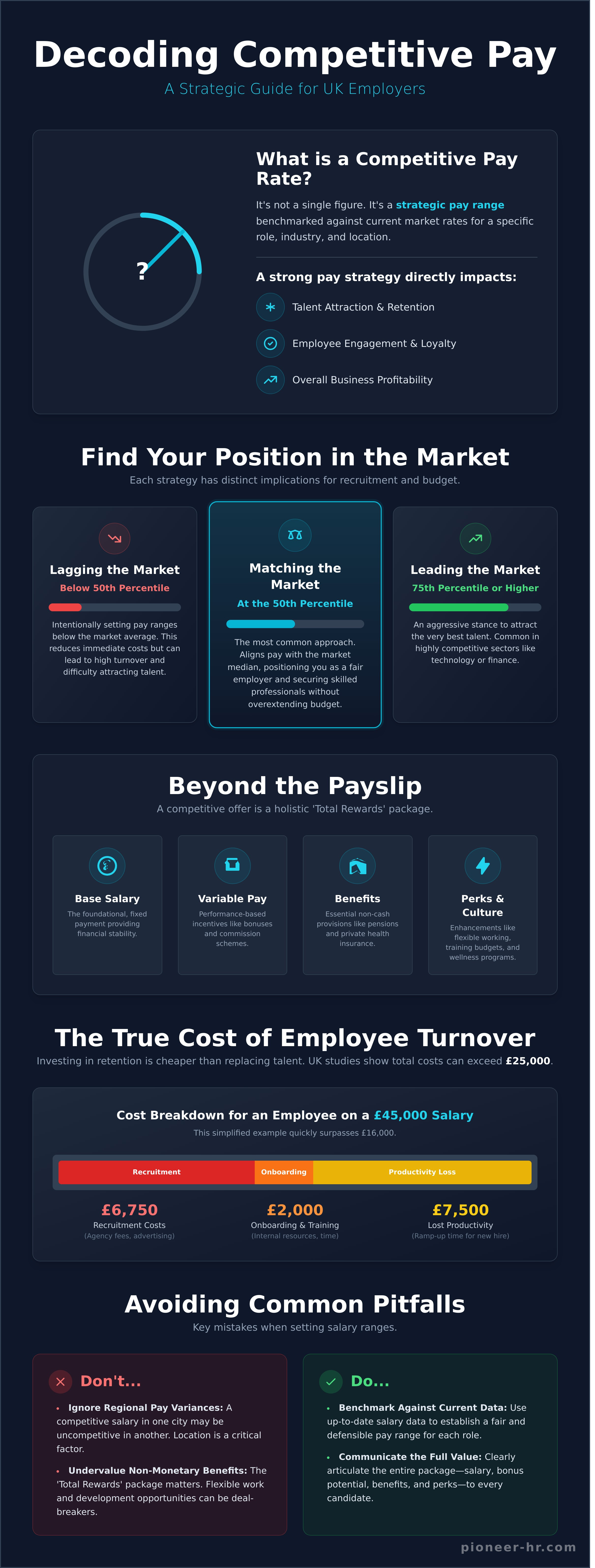
For UK employers, understanding what is a competitive pay rate is a cornerstone of a successful talent strategy. It is not a single, fixed figure but rather a strategic pay range that aligns with the market average for a specific role, considering factors like industry, geographical location, and the required level of experience. A competitive rate ensures your organisation can attract, retain, and motivate the high-calibre professionals needed to drive business growth.
Crucially, determining where your company positions its pay is a conscious business decision. It reflects your employer brand, your financial realities, and your long-term goals. This decision directly impacts your ability to compete for talent in a dynamic marketplace.
The Three Tiers of Market Positioning
When benchmarking against market data, businesses typically adopt one of three strategic positions. Each approach has distinct implications for recruitment and budget management:
Lagging the market: This strategy involves intentionally setting pay ranges below the market average (e.g., below the 50th percentile). While it reduces immediate payroll costs, it can make attracting top talent challenging and may lead to higher employee turnover.
Matching the market: The most common approach, this involves aligning pay with the market median, or the 50th percentile. It positions you as a fair employer and is a solid, defensible strategy for securing skilled professionals without overextending your budget.
Leading the market: Here, an organisation chooses to pay above the market average, often targeting the 75th percentile or higher. This aggressive stance is designed to attract the very best talent in the field and is common in highly competitive sectors like tech or finance.
Beyond the Payslip: Components of a Total Rewards Package
While salary is a critical factor, a truly competitive offer extends far beyond the monthly payslip. A comprehensive 'Total Rewards' package communicates the full value an employee receives. We find that a holistic view is essential for attracting and retaining talent today.
Base Salary: This is the foundational, fixed payment an employee receives. A fair base Salary provides financial stability and serves as the anchor for the entire compensation structure.
Variable Pay: These are performance-based incentives, including annual bonuses, sales commissions, or profit-sharing schemes, which reward individual and company success.
Benefits: Essential non-cash provisions that provide security and support, such as a workplace pension, private health insurance, and life assurance, are highly valued by UK employees.
Perks and Culture: This includes non-traditional benefits that enhance the employee experience, like flexible working arrangements, generous annual leave, professional development budgets, and corporate wellness programmes.
Why Offering a Competitive Pay Rate is a Business Imperative
Moving beyond a simple line item on a budget, a competitive salary is one of the most powerful strategic tools at your disposal. It is not merely an expense; it is a direct investment in your company's stability, productivity, and long-term growth. When we partner with businesses, we often find that shifting the perspective from cost to investment is the first step in building a resilient and high-performing team. Understanding what is a competitive pay rate for your sector is fundamental to unlocking these tangible business outcomes.
Attracting and Retaining Top Talent
In the UK's candidate-driven market, compensation is a critical factor in a professional's decision-making process. While culture and benefits are important, an offer that falls below the market rate is often a non-starter. Offering competitive pay immediately widens your talent pool, ensuring you attract a higher calibre of applicant. Crucially, it also acts as a powerful retention tool, reducing the risk of your most valuable employees being lured away by competitors.
Reducing Costly Employee Turnover
Employee turnover carries a significant and often underestimated financial burden. While exact figures vary, UK studies consistently show the total cost of replacing an employee-factoring in recruitment, training, and lost productivity-can easily exceed £25,000. Fair pay is a cornerstone of employee loyalty and a key driver in reducing attrition.
Consider this simplified example for an employee on a £45,000 salary:
Recruitment Costs: Agency fees, advertising, and management time. (e.g., £6,750 at 15%)
Onboarding & Training: Internal resources and time spent getting the new hire up to speed. (e.g., £2,000)
Lost Productivity: Time for a new employee to reach full effectiveness. (e.g., £7,500 over 3 months)
In this scenario, the cost quickly surpasses £16,000, illustrating how investing in retention through competitive pay delivers a clear return.
Boosting Morale, Engagement, and Productivity
Compensation is more than just money; it is a clear signal of how much an employee is valued. When individuals feel their pay is fair and reflective of their contribution, it fosters a sense of respect and psychological safety. This directly translates into higher engagement, greater discretionary effort, and improved performance. Conversely, feeling underpaid can lead to resentment, disengagement, and a decline in productivity. While meeting the legal minimums outlined in the official National Minimum Wage and Living Wage rates is a mandatory baseline, genuine employee commitment is built by going beyond this and demonstrating that you value their expertise at a competitive market level.
How to Determine a Competitive Pay Rate: A 4-Step Process
Defining a competitive salary isn't about guesswork; it requires a structured, data-driven approach. For UK SMEs, establishing a clear methodology ensures your pay structures are not only attractive but also fair, consistent, and legally compliant. The core of this process is salary benchmarking-a systematic method of matching your internal roles to external market data. By following these four steps, you can confidently answer the question "what is a competitive pay rate?" for every position within your organisation.
Step 1: Internal Role Analysis
Before looking at the external market, you must first have a crystal-clear understanding of your own roles. This begins with creating and maintaining accurate, up-to-date job descriptions. Each description should clearly define key responsibilities, required skills (both technical and soft), and the necessary level of experience. This foundational step ensures that when you gather external data, you are comparing 'apples with apples', matching your roles to their true market equivalents.
Step 2: Gathering External Market Data
With your roles clearly defined, the next step is to gather salary data. While free resources like the ONS, Glassdoor, or LinkedIn Salary can offer a starting point, they often have limitations, such as being self-reported, lacking detail, or not being current. For a more accurate picture, we recommend using professional, robust salary survey data. This allows you to filter by crucial variables like industry, UK location (e.g., London vs. the North West), and company size. A well-structured process, as outlined in guides like the U.S. Chamber of Commerce's article on How to Do a Salary Competitive Analysis, is vital for gathering meaningful insights.
Step 3: Analysing Data and Setting Pay Bands
Once you have reliable data, you can establish pay bands (or salary ranges) for each role. These bands are typically structured around market percentiles. For instance:
25th Percentile: Often represents the starting point for employees who are new to the role or still developing their skills.
50th Percentile (The Median): Represents the average market rate for a competent, experienced employee. This is the most common benchmark.
75th Percentile: Typically reserved for employees with extensive experience, specialised skills, or exceptional performance.
Using these percentiles, you can create a range with a defined minimum, midpoint (target salary), and maximum for each position.
Step 4: Building Your Compensation Strategy
Finally, you must decide where your organisation wants to position itself in the market. Will you lead (paying above the 50th percentile to attract top talent), match (aligning with the market median), or lag the market (paying below the median, often offset by other benefits)? Remember that salary is just one part of your Total Rewards package. Your company culture, benefits, and career development opportunities are all crucial components of a compelling offer. This holistic view is key to determining what is a competitive pay rate for your unique business.
Need expert support with reliable UK market data? Our Salary Benchmarking service can help.
Common Pitfalls to Avoid When Setting Pay Rates
Establishing a competitive compensation strategy is a continuous process of refinement. While determining pay rates, even the most diligent businesses can encounter several common challenges. Viewing these not as failures, but as learning opportunities, allows you to build a more robust and equitable framework that attracts and retains top UK talent. By understanding these pitfalls, you can proactively strengthen your approach.
The Danger of Unreliable or Outdated Data
Basing critical salary decisions on flawed information is one of the most significant risks. Free online salary checkers often use self-reported, aggregated data that may not accurately reflect the nuances of your specific industry, company size, or location within the UK. This can lead to offering too little and losing your ideal candidate, or overpaying and straining your budget. We always recommend investing in professional, up-to-date market data to ensure your decisions are commercially sound and strategically aligned.
Ignoring Your Total Rewards Package
A frequent oversight is focusing exclusively on the base salary figure, forgetting that compensation is more than just a number on a payslip. Your total rewards package offers significant value that must be clearly communicated. A strong benefits offering can be a powerful differentiator in the market. Consider the full value of elements such as:
Generous pension contributions
Private health and dental insurance
Flexible and remote working policies
A dedicated professional development budget (£)
A positive and supportive company culture
When candidates understand the complete picture, a salary positioned at the market median can become far more attractive than a higher offer with minimal benefits.
Lack of Consistency and Transparency
Inconsistencies in pay for employees in similar roles, without clear justification based on experience or performance, can quickly erode morale and trust. This lack of internal equity can lead to disengagement, higher staff turnover, and even potential equal pay claims. While full salary transparency isn't right for every business, transparency in your process is crucial. Communicating how pay bands are determined demonstrates a powerful commitment to fairness.
The 'Set It and Forget It' Approach
The UK labour market is not static. Inflation, competitor strategies, and shifting talent demands all impact compensation benchmarks. Answering the question of what is a competitive pay rate is not a one-time task; it requires ongoing attention. A pay structure that was competitive two years ago may be obsolete today. We recommend a formal review of your salary bands at least annually. This proactive approach ensures your compensation remains attractive, protecting your business from talent attrition over the long term.
Transforming Compensation into Your Competitive Advantage
In today's dynamic UK market, understanding what is a competitive pay rate is more than a defensive measure-it's a strategic imperative for sustainable growth. As this guide has demonstrated, the key lies in moving beyond a simple salary figure to embrace a holistic total rewards philosophy. A well-structured, data-driven compensation plan is not merely an operational cost; it is a direct and powerful investment in your company's culture, employee morale, and ability to secure the very best talent.
Navigating the complexities of salary benchmarking requires precision, market insight, and expertise. With over 30 years of strategic HR experience, Pioneer HR is your dedicated partner in this critical process. As specialists in UK salary benchmarking for SMEs, we provide the clarity and confidence you need to build a truly motivated and high-performing workforce. We work alongside you to translate data into a compensation strategy that reflects your company's values and drives its ambition forward.
Frequently Asked Questions About Competitive Pay
How often should a business review its pay rates?
We recommend a formal review of your company’s pay rates at least once a year. This allows you to adjust for inflation, respond to market shifts, and ensure you remain competitive. For businesses in fast-moving sectors like tech, or during periods of high talent demand, more frequent reviews, perhaps bi-annually, may be necessary. Proactive analysis prevents you from falling behind the market and helps with talent retention, making it a crucial part of your strategic HR planning.
What is the difference between a competitive salary and total compensation?
A competitive salary refers specifically to the base wage an employee earns. Total compensation, however, is a much broader concept encompassing the entire value of an employee's reward package. It includes the base salary plus all other financial and non-financial benefits, such as pension contributions, performance bonuses, private health insurance, and professional development budgets. Understanding this difference is key when defining what is a competitive pay rate for your organisation in a holistic sense.
Should we include salary ranges in our UK job adverts?
Yes, we strongly advise including salary ranges in your UK job adverts. This practice is rapidly becoming a standard for transparency and fairness. It attracts more suitable candidates who know their expectations can be met, saving time for both your hiring team and the applicant. Publishing a clear range demonstrates confidence in your pay structure, builds trust from the outset, and positions your company as a modern, equitable employer in a competitive talent market.
How can a small business afford to pay competitively against larger companies?
While matching the base salaries of large corporations can be challenging, smaller businesses can compete effectively by focusing on their total compensation package. Emphasise non-monetary benefits that larger firms may not offer, such as greater workplace flexibility, a stronger sense of community and culture, or meaningful equity options. Highlighting opportunities for direct impact and faster career progression can also be a powerful differentiator that attracts ambitious talent without inflating your payroll costs.
What is pay equity and why is it important?
Pay equity is the principle of providing equal pay for work of equal value, regardless of an employee's gender, ethnicity, or other protected characteristics. In the UK, this is not just a best practice but a legal requirement under the Equality Act 2010. Ensuring pay equity is crucial for fostering a fair and inclusive workplace culture, improving employee morale and retention, strengthening your employer brand, and mitigating significant legal and reputational risks.
How do you communicate a new pay structure to existing employees?
Communicating a new pay structure requires transparency, clarity, and empathy. We recommend starting with a company-wide announcement that explains the rationale behind the changes, such as achieving market alignment or enhancing fairness. Follow this with team-level briefings and provide clear documentation on the new salary bands. Crucially, managers should hold one-to-one meetings with each team member to discuss their individual position within the new framework, answer questions, and build trust in the process.


Comments