
Pay Scale Creation: A Practical Guide for UK Employers
What if the problem with your pay decisions isn’t the salary figures, but the lack of a clear framework behind them? When different managers apply different standards, employees can find it hard to understand how pay is set or how they can progress. For UK employers, a pay scale creation service can bring role value, relevant market evidence and organisational priorities into one practical approach.
It’s understandable to want ranges that are fair internally and realistic for the market, whether your organisation is in London, Kent or elsewhere in the UK. Getting that balance takes more than comparing job titles or copying salary data. It means making considered choices about roles, grades and progression.
In this guide, we’ll explain what a structured pay scale involves, which inputs can inform its design and how to assess your options. We’ll also look at how salary benchmarking, job grading and reward strategy can support more consistent decisions and keep the framework workable as your organisation changes. Pioneer HR’s salary benchmarking and pay structure review work can help you bring evidence into the process and shape an approach around your priorities.
Table of Contents
Why create a pay scale instead of making salary decisions case by case?
When managers make pay decisions independently, similar roles can be assessed differently. One manager may focus on experience, another on current market rates, while a third relies on what the team has paid historically. Each decision may have a rationale, but without shared principles it can be difficult to explain how they fit together. A pay scale gives managers a common reference point, while leaving room to consider relevant differences between roles and individuals.
A pay scale is a framework of structured pay ranges linked to roles and levels, supported by clear principles for placing and progressing people within those ranges. It is more than a list of current salaries: a list records what people are paid today, but doesn’t explain how pay should be set. Nor is a pay scale the same as a one-off salary review, which assesses pay at a particular point in time. For a useful foundation on the concept, see What is a Pay Scale?
What a pay scale can clarify for a growing UK employer
Shared criteria help managers prepare for pay discussions and explain the factors behind a decision. These might include the scope of a role, its level of responsibility, relevant skills and the organisation’s approach to progression. The aim isn’t to make every decision identical. It’s to make the reasoning more consistent and easier to follow.
Role clarity matters as a business grows. Imagine a small Kent employer where one team has taken on new responsibilities and reporting lines have shifted. If job descriptions haven’t kept pace, managers may be comparing roles based on outdated assumptions. Reviewing role scope alongside the organisation chart helps clarify which positions are genuinely comparable before pay ranges are designed.
When a pay structure may need a fresh look
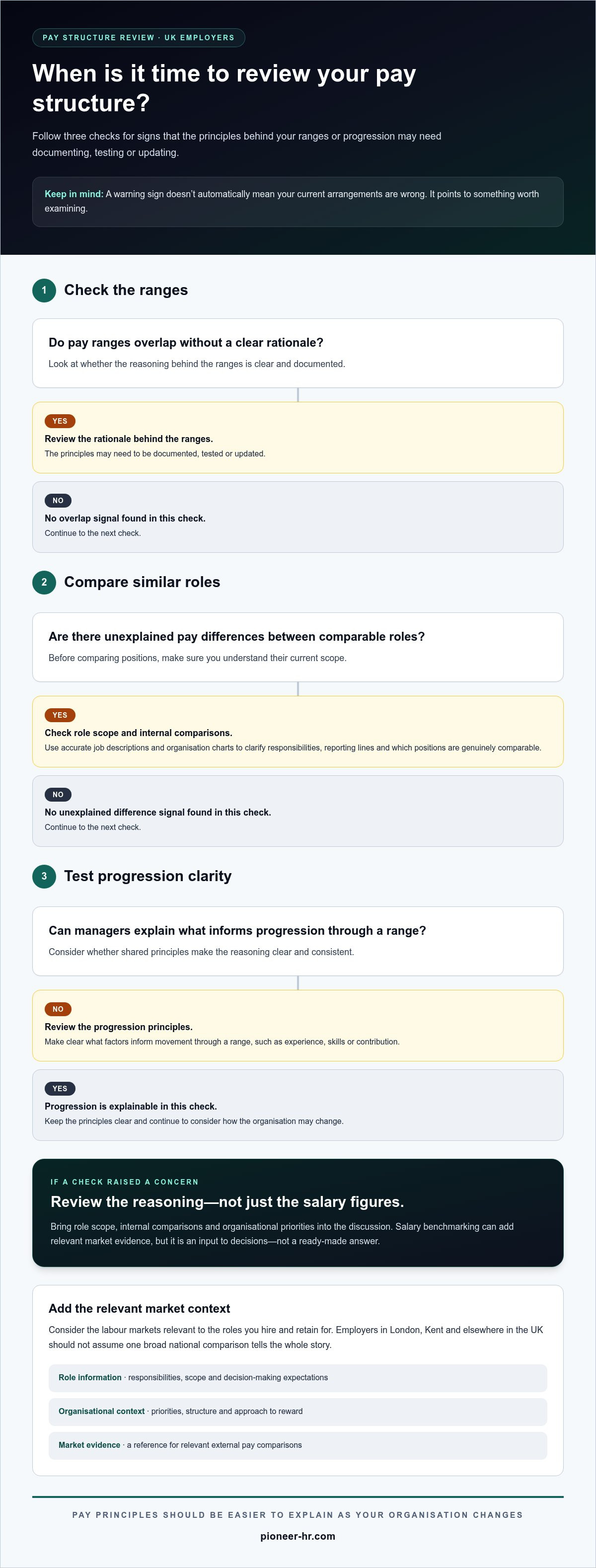
A structure may deserve review when ranges overlap without a clear rationale, employees in comparable roles have unexplained differences, or managers can’t explain what informs progression. These signs don’t automatically mean the current arrangements are wrong. They do suggest that the principles behind them may need to be documented, tested or updated as the organisation changes.
External evidence can help you assess whether pay ranges remain relevant, but it shouldn’t make the organisation’s decisions for you. Employers in London and Kent may need to consider the labour markets relevant to the roles they’re hiring and retaining for, rather than assuming one broad national comparison tells the whole story. Salary benchmarking brings market data into the discussion alongside internal role comparisons and organisational priorities.
A pay scale creation service can help bring these considerations into a practical structure, rather than treating each salary question as a standalone decision. Start by identifying where the current approach creates uncertainty, then agree what a clearer framework needs to help managers decide.
What goes into a well-designed pay scale?
A pay scale connects roles and levels to defined pay ranges, giving an organisation a consistent structure for setting and reviewing salaries. Designing one means bringing together three kinds of information: what each role involves, what the organisation can support and prioritise, and relevant evidence about the external market. The right balance depends on the organisation, so market data is an input to decisions, not a ready-made answer.
Salary benchmarking shows how pay compares with external market information; a complete pay scale turns that evidence, alongside role value and organisational priorities, into a framework for pay decisions. That distinction matters: benchmark data can inform where a range might sit, but it doesn’t decide which roles belong together or how employees should progress within a range.
It also helps to separate the value assigned to a role from an individual’s pay placement. First, the organisation establishes how roles relate to one another and what ranges apply. Then it considers where a particular employee sits within the relevant range, using agreed factors such as experience, skills or contribution. Keeping these decisions distinct makes the structure easier to explain and apply consistently.
Role information describes responsibilities, scope and decision-making expectations.
Organisational context includes priorities, structure and the approach to reward.
Market evidence provides a reference for relevant external pay comparisons.
How job grading helps organise roles
Job grading groups roles according to consistent, documented criteria, such as responsibility, complexity and the scope of decisions involved. A grade doesn’t need to make different jobs identical; it provides a shared way to discuss their relative levels across teams. For organisations establishing those levels, job grading support can help bring structure to the assessment.
How ranges, market data and progression principles fit together
A range’s minimum, midpoint and maximum can mark its lower point, a reference point around the middle, and its upper point. They aren’t universal values or automatic rules for placing employees. Progression principles explain how someone might move through a range and what factors inform that decision. Clear principles help managers apply the structure thoughtfully, rather than treating the midpoint as a guaranteed target or the maximum as an entitlement.
External comparisons can help test whether proposed ranges make sense for relevant roles and markets, while internal role value and budget priorities remain part of the decision. The UK Government’s Civil Service pay remit guidance offers an example of formal pay frameworks in a public-sector context, though its specific arrangements aren’t a template for every employer. A pay scale creation service can bring role assessment, market evidence and progression principles into one tailored design process, with decisions grounded in your organisation’s needs.
Which pay scale approach fits your organisation?
The right structure depends on how varied your roles are, how much flexibility managers need and how much administration the organisation can sustain. A framework that works for a small team with a few role families may feel too loose for an employer with distinct functions, locations and career paths. The aim is not to choose the most elaborate model, but one people can understand and apply.
Job-based bandsRoles are grouped into defined grades or bands, often using a consistent assessment of their scope and responsibilities. This can make role relationships clearer, although the structure needs to be maintained as jobs change.
Broad bandsFewer, wider ranges give managers more room to reflect differences in experience or contribution. That flexibility can be useful, but it relies on clear guidance so decisions don’t become inconsistent within a broad band.
Role-level frameworkA simpler structure links roles or role families to levels, with less emphasis on detailed grades. It can be easier to manage in a smaller organisation, though it may offer less distinction between jobs as the organisation grows.
These are design choices, not fixed rules. A small Kent business with a handful of role families may favour a straightforward level structure. An employer with specialist teams across London and other locations may need more defined bands to make comparisons between functions easier. Location can inform which external labour markets are relevant, but it doesn’t automatically determine a role’s value or place in the internal structure.
How organisation size and role variety affect the choice
Consider how many distinct types of work the framework needs to cover, whether roles share comparable responsibilities, and how often teams or reporting lines change. More variety can call for clearer grading and documentation; a simpler organisation may find a lighter approach easier to maintain. Choose a structure that matches the decisions managers actually need to make, rather than adding complexity for its own sake.
There’s also a choice about how to design the framework. An internally led project can suit an organisation with enough HR capacity, reliable role information and agreement among decision-makers. Specialist project-based support can be useful where the design involves complex job comparisons, market analysis or a review of how pay principles fit together. A pay scale creation service should support informed organisational decisions, not replace them with a template.
How to weigh internal consistency against market competitiveness
Internal comparisons ask how roles relate to one another; market evidence asks how pay for relevant roles compares externally. Those questions can point in different directions, so record the reasoning when you choose to prioritise one consideration or make an exception. For example, a hard-to-fill specialist role might warrant a different market position, while its internal level remains based on the organisation’s role criteria.
Clear review principles can keep a structure from becoming rigid. Define who can approve an exception, what evidence should support it and when the framework itself should be revisited. Wider reward strategy principles can help connect pay decisions with the organisation’s broader approach to recognising and supporting employees.
How to prepare for a pay scale creation project
A well-prepared project starts with decisions about purpose and ownership, not a spreadsheet of salaries. Before designing ranges, agree what the framework needs to support: clearer role relationships, more consistent decisions, planned growth, or a combination of these. This focus helps keep the work practical and guides which information needs to be gathered.
A pay-scale project needs a clear purpose, accurate role information, reliable current pay data, informed decision-makers and agreed principles for making and reviewing decisions. These inputs allow the design to reflect how the organisation operates, rather than relying on job titles or incomplete records.
Define the purpose. Set out what the organisation wants the framework to clarify or support.
Assemble role information. Gather current job descriptions and organisation charts, noting where responsibilities or reporting lines have changed.
Identify decision-makers. Involve the people who understand roles, budgets and organisational priorities.
Review current pay. Bring together existing pay information in a consistent format, stored securely and available only to those who need it for the project.
Agree principles. Decide what will inform role levels, range placement, progression and any exceptions.
What information and people to bring into the process
Useful starting materials include role descriptions, reporting lines, current pay information and a summary of organisational priorities. Accurate job descriptions help distinguish a role’s actual responsibilities from assumptions based on its title. Organisation charts show where accountability sits and how roles relate, which is especially useful when teams have changed or grown.
Bring in HR, finance and business leaders where they hold relevant information or will make decisions. HR can coordinate role information and process; finance can contribute budget context; business leaders can explain operational priorities and role scope. Employee communication planning is also worth considering, but it’s usually most useful once design principles and decisions are established, so the organisation can explain what the framework means in clear, consistent terms.
How to turn the framework into workable decisions
Before managers use the framework, agree who is responsible for placing roles and employees within ranges, who can approve exceptions, and how decisions should be recorded. A short, shared decision guide can help managers apply the structure consistently while making room for considered judgement. Without clear ownership, even a carefully designed framework can be interpreted differently across teams.
Set a planned review point so the structure can be reconsidered as roles, organisational priorities and relevant labour markets change. The review doesn’t have to mean redesigning everything; it gives you a chance to check whether the framework remains useful. Where UK legal references are relevant to project decisions or communications, verify them against current authoritative guidance rather than relying on assumptions.
Pioneer HR’s project-based salary benchmarking includes market data analysis and pay structure reviews, helping employers bring role information, market evidence and organisational decisions into a coordinated project. Discuss your pay scale project with Pioneer HR to explore tailored support for your organisation.
What to expect from Pioneer HR’s pay scale creation support
A pay structure project brings together organisational choices, role information and evidence about the market. Pioneer HR’s project-based salary benchmarking includes market data analysis and pay structure reviews, helping employers examine how current arrangements relate to internal roles and relevant external information. The evidence supports your decisions; it doesn’t make them on your behalf.
Depending on the organisation’s needs, job grading can help clarify how roles relate to one another, while reward strategy can connect the structure with wider priorities. The aim is a tailored approach that reflects your context, rather than a standard model applied regardless of how your organisation works. Pioneer HR’s founder brings over 30 years of industry experience, informing the practical perspective brought to this work without promising a particular outcome.
How benchmarking and structure review can work together
Market analysis provides context for considering pay ranges, while an internal structure review looks at how roles sit alongside one another and how current arrangements are organised. These perspectives answer different questions. External information can indicate how relevant roles compare with the market; internal assessment helps the employer consider whether role relationships and priorities are reflected in its approach.
Used together, they can give decision-makers a more considered basis for shaping or reviewing a framework. Salary benchmarking remains an evidence input, not a substitute for choices about pay principles, affordability or how the organisation wants to position roles. Pioneer HR’s salary benchmarking can support this evidence-led part of the discussion alongside a pay structure review.
How to decide whether to start a conversation
Before beginning, identify the specific questions you want to resolve. Are role levels unclear? Are managers applying different reasoning? Do you need to understand how existing pay arrangements compare with relevant market information? A focused starting point helps shape a useful discussion about the organisation’s priorities and the decisions the work needs to inform.
UK employers, including organisations in London and Kent, can bring their particular structure, role mix and challenges into the conversation. You don’t need to have every answer in place; a clear sense of what feels difficult or inconsistent is a practical start. Discuss your pay structure with Pioneer HR to explore how benchmarking and structure review could fit your organisation.
Your next decision is what you want the project to clarify, whether that’s role relationships, the use of market evidence or the principles managers apply. Once that priority is clear, you can consider the right level of tailored support. Start a conversation about your pay structure when you’re ready.
Give your pay framework room to grow
A pay structure is most useful when it can guide decisions today and still make sense as the organisation changes. Treat its first version as a considered foundation, not a document that can never be revisited. As responsibilities evolve and business priorities shift, keep the principles clear and make space to review whether they remain relevant.
A practical next step is to identify the decision that would benefit most from greater clarity. Is it how roles relate, how managers apply ranges, or how your organisation weighs internal priorities against market evidence? That question can help shape a focused conversation and make the work more manageable, whether your team is based in London, Kent or elsewhere in the UK.
A tailored pay scale creation service can help you work through those choices with a clear view of your organisation’s context. Pioneer HR brings a partnership-led approach to the decisions behind a workable pay framework, drawing on salary benchmarking, pay structure reviews and related HR expertise.
Explore tailored pay structure support and take the next step towards a framework that can grow with your organisation.
Frequently Asked Questions
Do small businesses need a formal pay scale?
Not every small business needs a detailed grading system, but even a short set of written pay principles can help owners make decisions consistently as they hire or reshape roles. A pay scale creation service may be useful if pay questions are becoming difficult to resolve informally. For a small team, the outcome could be a proportionate framework that records how roles are assessed, without adding layers of process the business doesn’t need.
Can a pay scale be flexible when roles change?
Yes. A pay scale can accommodate change if the organisation has a way to assess whether a role’s responsibilities have shifted enough to affect its level or range. For example, a role that takes on budget ownership or manages a new function may need a fresh assessment, rather than an automatic pay adjustment based only on a changed job title. Clear review and approval steps help managers handle changes thoughtfully.
How often should an employer review its pay scales?
There’s no single review interval that suits every UK employer. Set a planned review point that fits your organisation’s budgeting and reward planning, then bring it forward if there’s a material change, such as restructuring, new role families or difficulty applying the framework. A review doesn’t have to mean changing pay ranges. It can check whether the structure and its decision principles still reflect how the organisation works.
Should every employee in the same grade receive the same salary?
No. A grade can contain a range, so employees at the same level may be paid differently where the organisation has clear, relevant reasons. Those might include differences in role-specific expertise or the responsibilities an employee currently carries, if these factors are part of the employer’s agreed approach. The key is to apply the same reasoning consistently and avoid treating grade membership as either an automatic salary figure or an explanation by itself.
Can a pay scale help explain differences in employee pay?
It can give managers a structured way to explain how roles are positioned and what factors may influence pay, but it doesn’t automatically explain or justify every difference. If two employees appear to be in comparable roles but their pay differs, review the available rationale against the organisation’s principles. Where the explanation is unclear or unsupported, treat that as a prompt to examine the decision, not simply to rely on the framework.
Is salary benchmarking enough to create a pay scale?
No. Benchmarking can help show how pay for selected roles compares with relevant market information, but job titles alone may not reveal whether roles have similar scope or responsibilities. Employers also need to decide how roles relate internally and what principles guide pay decisions. For instance, two posts with similar titles may have different levels of accountability, so market comparisons need to be interpreted alongside accurate role information and organisational priorities.
Can pay scales work across different UK locations?
Yes. An employer can use a shared structure across UK locations, while deciding whether local market evidence warrants location-sensitive ranges or other clearly defined treatment. The answer depends on the roles, recruitment markets and how the organisation operates. For example, a business with teams in London and Kent can assess whether a role faces meaningfully different market conditions in each location, then document and apply any resulting approach consistently.



Comments