
Job Evaluation and Grading Consultant: A UK Employer’s Buying Guide
What if the fairest pay framework starts by setting market salaries aside? For UK employers, unclear role levels, outdated job descriptions and titles that no longer reflect day-to-day responsibilities can make pay and progression decisions difficult to explain. A job evaluation and grading consultant can help you compare the requirements of roles and create a clearer basis for consistent internal decisions.
Job grading clarifies how roles relate within your organisation, while salary benchmarking adds external market context. Keeping these steps connected but distinct can help employers in London, Kent and across the UK build a structure that reflects their own roles, rather than adopting a framework that misses important differences between teams.
This guide explains what a consultant can help you achieve, how to assess their approach and what to prepare before starting. It covers how to compare responsibilities, define practical role levels and use benchmarking to inform pay without treating market data as a substitute for evaluating the work itself.
Table of Contents
What a Job Evaluation and Grading Consultant Helps UK Employers Achieve
When role levels have developed informally, similar work can sit at different levels, while roles with distinct responsibilities may share a title. That makes reward and progression decisions harder to explain and can leave managers relying on inconsistent comparisons. A structured review gives employers a clearer way to understand how roles relate, without assuming every organisation needs the same model.
Job evaluation assesses the relative value of roles against agreed criteria; employee appraisal assesses an individual’s performance. Evaluation focuses on the work, including its responsibilities, scope and required contribution, rather than the person currently doing it. Job evaluation is commonly described as a systematic way to compare the relative worth of jobs. The findings can inform a grading structure that groups roles into levels using criteria chosen for the organisation.
For example, an employer in London might have expanded teams quickly, leaving specialist and management roles with overlapping titles. A Kent-based organisation might have changed how it delivers services while its role descriptions still reflect an earlier structure. In both cases, the useful starting point is what each role involves now, not just its title or the postholder’s place in the organisation chart.
What does a job evaluation and grading consultant do?
A job evaluation and grading consultant helps an employer assess roles consistently against agreed criteria. The work can include reviewing role information, identifying gaps or overlaps in responsibilities, and facilitating evaluation discussions so decisions rest on a shared understanding of the work. The consultant can also help turn findings into a usable grading structure, with level descriptions that managers and employees can understand.
The framework should fit the organisation’s context. One employer may need to distinguish increasing levels of specialist expertise; another may need to clarify how decision-making responsibility differs across teams. When reviewing a proposed approach, ask how it will account for those distinctions and how the resulting levels will be explained in everyday terms. For further information on role grading, see this guide to job grading.
When might an employer need job grading support?
A review may be useful when role complexity has grown, titles have become inconsistent, or employees and managers are unclear about what separates one level from another. These issues can surface as teams expand, responsibilities shift or career paths develop unevenly across departments.
Restructuring or organisational redesign can also prompt a closer look. If reporting lines, team responsibilities or specialist functions are changing, existing grades may no longer describe the work clearly. A review can help the employer examine its role structure and agree how roles should be compared under the new design. It is a practical way to make responsibilities and levels easier to explain, not a legal test or a promise of a particular reward outcome.
How Job Evaluation, Job Grading, and Salary Benchmarking Fit Together
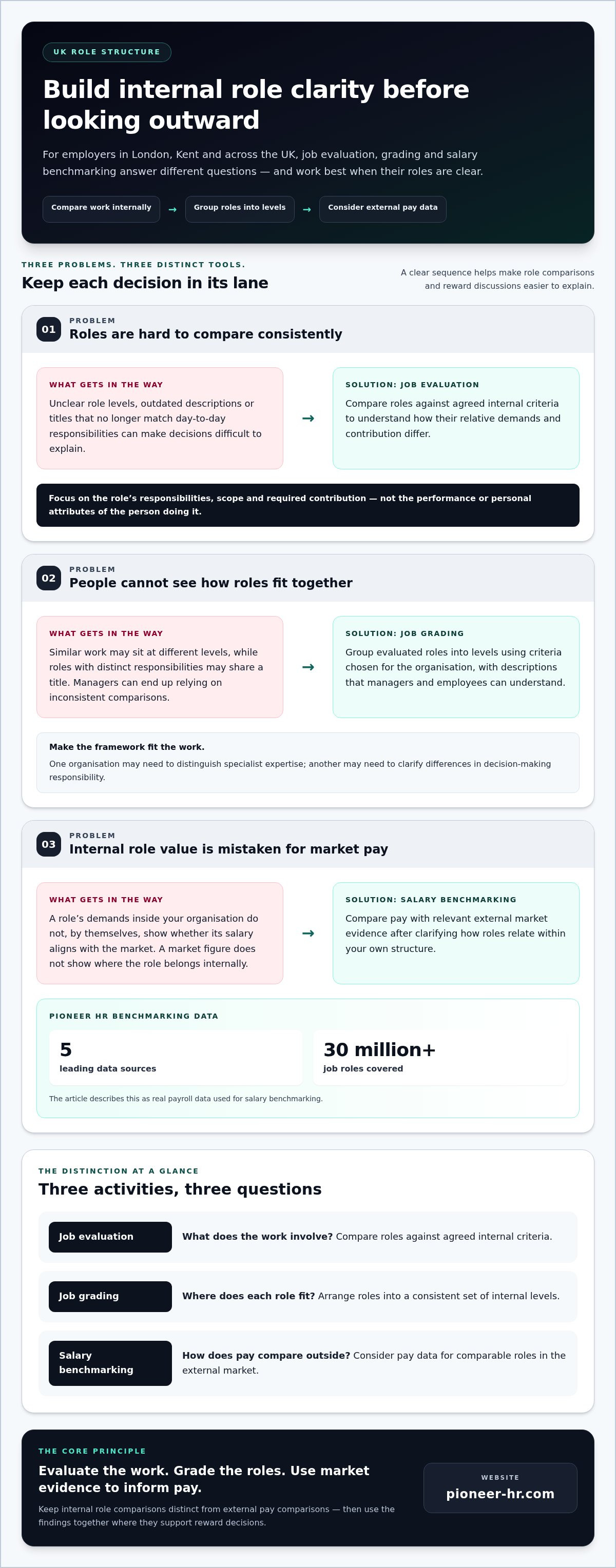
These activities are related, but they answer different questions. Job evaluation compares roles within your organisation; grading groups those outcomes into levels; salary benchmarking looks outwards to compare pay with market evidence. Keeping the distinction clear helps you build a reward structure that reflects your organisation’s needs alongside external pay conditions.
Job evaluation versus salary benchmarking
Evaluation is an internal comparison: it considers the work and responsibilities of roles in your organisation. Benchmarking is an external comparison: it considers pay information for roles relevant to the market you are reviewing. Internal role value explains how jobs relate to one another in your organisation; external market pay shows how comparable work is paid elsewhere.
Neither activity automatically replaces the other. A role might be demanding within your organisation, but that alone does not establish whether its salary is aligned with the market. Likewise, a market salary figure will not show how that role should sit alongside others in your structure. Pioneer HR’s Salary Benchmarking uses real payroll data from five leading sources, covering over 30 million job roles. For more context on using market-pay evidence, see this guide to Salary Benchmarking UK.
A job evaluation and grading consultant can help keep these stages distinct while making the findings useful together. Evaluation can establish how a role compares internally, grading can show its place in the structure, and benchmarking can then inform discussion of appropriate pay positioning.
How grading connects roles to reward decisions
Once roles have been evaluated, grading groups roles with comparable levels of responsibility or other demands under the chosen framework. A grade is a level, not a salary amount. An organisation decides how its grades relate to pay through its wider reward arrangements. This allows employers to use grades as a consistent reference point without assuming that every role in one grade must have identical pay.
Grades can support clearer decisions about pay structures, progression and how reward principles apply across teams. The Institute for Government’s explanation of Civil Service Grades and Pay offers a UK public-sector example of grades and pay operating within a broader structure. An employer’s own framework should reflect its circumstances. If you are considering how grading fits with wider reward choices, Pioneer HR’s reward strategy guidance can help connect those decisions to your organisation’s priorities.
How to Compare Job Evaluation and Grading Consultants
A sound methodology matters, but it is only part of the decision. The right job evaluation and grading consultant should understand how work is organised in your business, explain how the framework will be applied and help your team use the results. A polished report has limited value if managers cannot understand the conclusions or apply them consistently.
Compare approaches based on fit and delivery, rather than assuming one method suits every employer. The framework should reflect your organisation’s roles, priorities and decision-making, while giving you a clear process for reaching and explaining evaluation outcomes.
Assess the framework and its fit with your organisation
Role scope, responsibilities and reporting relationships help show what a role involves. Consider whether the proposed approach can make meaningful comparisons across different functions and levels, from specialist work to roles with broader organisational responsibility. The criteria should be applied consistently without flattening genuine differences between types of work.
Use these points to guide your discussion:
Role understanding: How will the consultant understand what roles involve, rather than relying on titles alone?
Framework fit: How will the criteria reflect your organisation’s context and account for differences between teams?
Clear outputs: What will you receive, such as role assessments, grade definitions or guidance for applying the structure?
Decision ownership: Which decisions will the consultant advise on, and which will remain with your organisation?
Use of outcomes: How will evaluation and grading inform reward or progression decisions, and how will those decisions be communicated?
These questions help show whether an approach is genuinely suited to your organisation or simply uses familiar terminology. Two organisations may have roles with similar titles but very different authority, specialist demands or impact. The framework needs to recognise those distinctions while applying its criteria consistently.
Look beyond the report to delivery and adoption
Ask how recommendations will become practical decisions. A useful process should leave your team with clear outputs and an understanding of how to apply them, not just a document to file away. It should also allow discussion where role information is incomplete or responsibilities have changed, so decisions are based on a sound picture of the work.
For an internal HR team, an external specialist can provide an informed second pair of eyes, helping test assumptions, identify inconsistencies and support shared understanding across managers. Your organisation should retain ownership of its decisions, while the consultant brings structure and an independent perspective. Pioneer HR works with UK employers on people and reward priorities, including Organisational Design, Salary Benchmarking and Reward and Benefits Review.
Before proceeding, agree the expected outputs, who will make final decisions and how the findings will be used. That clarity keeps the work focused and gives managers a stronger basis for applying the resulting structure consistently.
What to Prepare Before Starting a Job Grading Review
A little preparation can make a job grading review more focused, but you do not need to resolve every question before it begins. The aim is to give the consultant a useful picture of your organisation and agree what you want the framework to help with. A job evaluation and grading consultant can then work with you to examine the information, identify gaps and support decisions, rather than simply process a set of documents.
Gather role and organisation information
Start with the role information you already have. Current job descriptions, organisation charts and relevant reward information can help show responsibilities, reporting lines and how roles relate across teams. Check whether descriptions still reflect the work people do, especially where duties have changed or titles have remained the same through organisational change.
Useful inputs may include:
Current role descriptions, including known changes to responsibilities or scope.
An organisation chart showing reporting relationships and team structures.
Available reward information that may provide context for later decisions.
Notes on roles or departments where responsibilities overlap or have evolved.
These materials are a starting point, not a test of how complete your documentation is. If descriptions are out of date or inconsistent, identifying that early can focus discussions on the work as it is currently carried out. Managers and role holders can add practical context where documents do not tell the full story.
Agree the purpose, stakeholders, and next steps
Before work begins, clarify what decisions the framework should help inform. You might want greater consistency in role levels, support for progression discussions or a clearer basis for reward decisions. Agree who will contribute information, who will review recommendations and who retains responsibility for final decisions. HR colleagues can coordinate the process, while relevant managers can explain how roles operate across functions.
Keep the consultant’s role distinct from the employer’s. A consultant can structure the evaluation, interpret role information and discuss the implications of possible outcomes; your organisation brings the context and owns its decisions. Agree the intended outputs and how managers will use them, so the review connects to working practices rather than ending with a report.
If external market comparisons are also in scope, identify that separately from the internal evaluation. Pioneer HR’s Salary Benchmarking can provide market-pay context alongside, not in place of, role grading.
For UK employers, pay or grading questions with legal or regulatory implications should be checked against appropriate, current guidance. Keep that separate from preparing role information and agreeing project responsibilities. Pioneer HR typically onboards new clients within 2-4 weeks (or sooner if needed). This is an onboarding timeframe, not an estimate for completing a job grading review. To discuss your organisation’s wider HR and reward priorities, read more about role grading.
How Pioneer HR Supports Job Evaluation and Grading
Pioneer HR helps UK employers address role and reward questions through services including Organisational Design, Salary Benchmarking and Reward and Benefits Review. These services can support different parts of a wider review: organisational design examines structures, roles, responsibilities and reporting lines, while salary benchmarking adds external market context to pay decisions. The right starting point depends on the decisions your organisation needs to make.
A tailored, delivery-focused approach for UK employers
Our advice draws on over 30 years of commercial, real-world HR experience. We focus on practical application as well as strategic choices, helping you consider how responsibilities, role structures and reward decisions fit together. An employer in London reviewing specialist and management roles, for example, may have different organisational priorities from a Kent-based employer revisiting responsibilities after a redesign. The work should reflect those differences.
We can connect role and reward discussions with other relevant work. Salary Benchmarking can add external market context to internal role comparisons; a Reward and Benefits Review may help when you are considering how different elements of reward fit together. These activities complement one another but answer different questions.
Our approach is designed to work in partnership with your team. “We’re the only retained HR provider that embeds directly into your team.” That perspective supports collaborative, hands-on work, while recognising that your managers and HR colleagues hold important knowledge about how roles operate. Our service pricing is fixed-fee and transparent.
Taking the first step with Pioneer HR
Start by identifying what you want to understand: where role levels are unclear, how responsibilities have changed or how grading connects with wider reward priorities. New clients are typically onboarded within 2-4 weeks (or sooner if needed). This is an onboarding timeframe, not a promised completion date for a project. The work itself depends on the agreed scope and your organisation’s context.
A first conversation can help you decide whether this is the right time to review your role structure and what a practical next step could look like. You can explore information about role grading, or book a free 30-minute HR consultation to discuss your needs. It is a no-hard-sell opportunity to talk through your priorities and the support that may be useful.
Give Your Role Framework a Clear Next Step
A role framework is most useful when it reflects how your organisation works now and can adapt as responsibilities change. Rather than waiting until titles, levels or reward decisions become harder to explain, start by identifying where greater clarity would make the biggest practical difference.
A job evaluation and grading consultant can help turn that priority into a considered piece of work, using an approach shaped around your organisation and the decisions you need to make. You do not need to have every detail settled before beginning a conversation. A discussion can help identify the questions to resolve and the information that will support a useful review.
If you are ready to explore your organisation’s role and reward priorities, book a free 30-minute HR consultation with Pioneer HR. Talk through what you need and consider a sensible next step, with no pressure to proceed.
Frequently Asked Questions
Is job evaluation the same as salary benchmarking?
No. Job evaluation compares roles within your organisation, while salary benchmarking compares pay with relevant market data. They inform different decisions: internal comparisons can clarify how roles relate, while market evidence can inform how pay is positioned against external reference points. Pioneer HR’s Salary Benchmarking uses real payroll data from five leading sources, covering over 30 million job roles. Used together, these activities offer complementary context, but neither replaces the other.
Can a business review job grades without changing salaries?
Yes. Reviewing role levels and changing salaries are separate decisions, so an employer can examine its structure before deciding whether any pay action is appropriate. For example, a review might clarify how responsibilities differ between two grades without prompting an immediate salary change. The implications depend on the organisation’s circumstances and decisions; a grading review does not automatically require changes to pay.
How can job grading support fairer reward decisions?
Clear grades can give managers a more consistent basis for comparing roles and discussing reward, because decisions can refer to shared descriptions of role scope and responsibility. A framework supports decision-making, but does not guarantee that every outcome will be fair or legally compliant. Employers should consider how they apply it in practice and check specific legal questions against current UK guidance appropriate to their circumstances.
What information should we prepare for a job evaluation project?
Current role descriptions, reporting relationships and a clear explanation of the decisions you want the framework to support are useful starting points. For example, note where responsibilities have changed or where two teams describe similar work differently. These materials provide context for discussion, rather than forming a rigid checklist. If some documents are out of date, that can be discussed as part of understanding how roles operate now.
How much does a job evaluation and grading consultant cost?
Pioneer HR’s service pricing is fixed-fee and transparent. The work is scoped around the support required and the organisation’s needs. A free 30-minute HR consultation is a practical first step to discuss your requirements and relevant next steps, without committing to proceed.
How quickly can Pioneer HR start supporting a new client?
New clients are typically onboarded within 2-4 weeks (or sooner if needed). This describes the onboarding period, not the duration of a job evaluation project or a guaranteed completion date. Project timing is separate and depends on the agreed work and the organisation’s circumstances. Keeping the two distinct helps employers plan the start of support without assuming the review itself will be completed during onboarding.



Comments