
HR Audit Guide: What UK Employers Should Expect
What if an HR audit could help you decide what to tackle first, rather than simply uncovering problems? If you’re wondering what to expect from an hr audit, it’s reasonable to want clarity about which records and policies may be reviewed, who might need to take part, and what happens if gaps emerge. For employers across the UK, the value lies not just in identifying improvement areas, but in understanding how they connect to the organisation’s priorities.
A well-framed audit should give you a clearer picture of your people practices. Its scope and outputs need to be agreed for your organisation, rather than assumed. The findings should help you make practical decisions, not leave you with a list of issues without context.
In this guide, we’ll explain how an HR audit may be scoped, what information and colleagues you could prepare, and what to clarify about the process and final outputs. We’ll also look at how to assess and prioritise recommendations, so you can turn the findings into manageable next steps that fit your business.
Table of Contents
What to expect from an HR audit: purpose, scope, and boundaries
How an HR audit works: from agreeing the scope to reviewing evidence
What an HR audit may find, and what a useful report should clarify
How to prepare for an HR audit and turn findings into practical action
Choosing HR audit support: what to ask Pioneer HR before you begin
What to expect from an HR audit: purpose, scope, and boundaries
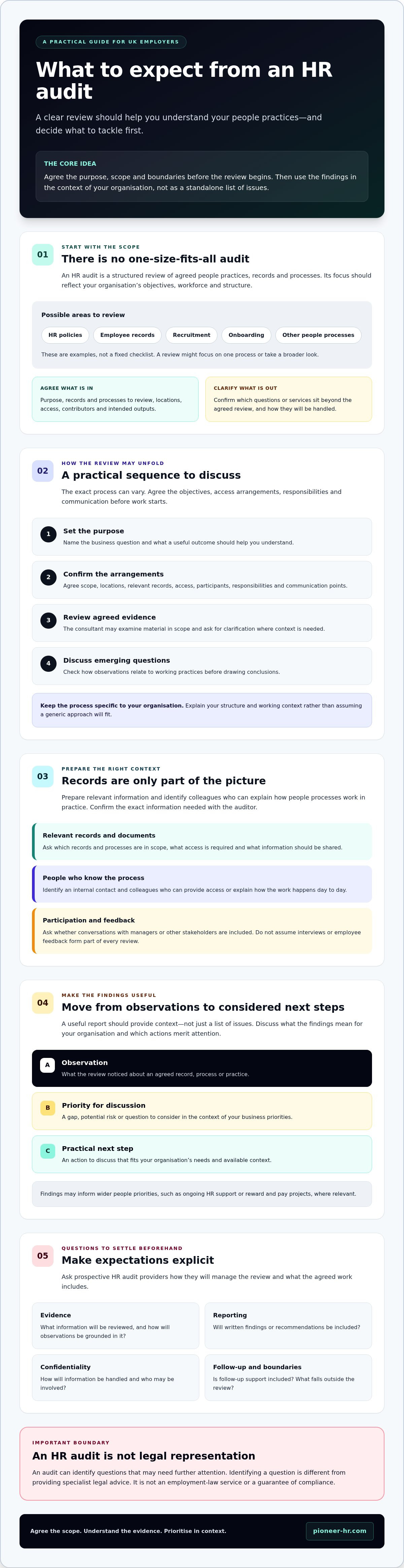
An HR audit reviews agreed people practices, records and processes to help an employer understand how they are working and where improvement may be needed. The phrase what to expect from an hr audit doesn’t have one universal answer. The review should be shaped around your organisation’s objectives, workforce and structure, with its scope agreed before work begins.
You might focus on a particular process, such as onboarding, or take a broader look at people practices. Either way, a clear scope helps everyone understand what evidence may be requested, who needs to contribute and what the review is designed to clarify. It can give you a structured view of strengths, gaps, potential risks and priorities for discussion, with findings considered in the context of your business.
What areas might an HR audit review?
Possible areas include HR policies, employee records, recruitment, onboarding and other people processes. These are examples, not a fixed checklist. The areas reviewed should reflect what you want to understand and what is relevant to your organisation’s size, structure and objectives.
HR practices sit within the wider discipline of Human Resource Management, but an audit needn’t cover every part of it. Before sharing information, ask the consultant to confirm which records and processes are in scope, what access they’ll need, and what is explicitly outside the review.
What an HR audit is, and what it is not
An HR audit is a structured review, not automatically a full organisational redesign. It can help identify where a process appears unclear or inconsistent and which questions may need further attention. The findings may point to issues that warrant specialist legal advice, but identifying a question is different from providing that advice.
An HR audit reviews people practices; it is not legal representation, an employment-law service, or a guarantee of compliance. Its value is in helping you make better-informed decisions about people priorities and possible next steps. Agree the boundaries at the outset, including whether recommendations, written findings or follow-up support are included, rather than assuming these form part of every audit.
How an HR audit works: from agreeing the scope to reviewing evidence
There isn’t one sequence that applies to every HR audit. The stages below are a practical illustration, not a description of Pioneer HR’s confirmed methodology. Before the review starts, the employer and consultant should agree the objectives, scope, access arrangements, responsibilities and how they’ll keep each other informed. A shared plan keeps the work focused on the business question you want answered.
Agreeing the audit scope and people involved
Start by identifying the concern or decision prompting the review. For example, do you want to understand how onboarding works across teams, or review a specific people process? Then discuss which teams and locations are relevant, what records may be needed, who can provide access and who will act as the internal contact. Explain your organisation’s structure and working context rather than assuming a generic approach will fit.
It’s also useful to clarify what is not in scope. If a question arises that needs specialist input beyond the agreed review, confirm who will raise it and how it will be handled. This can help prevent confusion later.
What happens during the review?
Depending on the agreed scope, a consultant may review relevant documents and processes, then ask questions to understand how they work in practice. Conversations with managers or other stakeholders could also form part of a review, but don’t assume interviews or employee feedback are included. Ask about the format, who may be involved, how information will be handled and what the consultant will need from your team.
A useful, illustrative sequence may look like this:
Set the purpose: Define the business question and what a useful outcome should help you understand.
Confirm arrangements: Agree scope, locations, relevant records, access, participants, responsibilities and communication points.
Review agreed evidence: The consultant may examine the material in scope and request clarification where context is needed.
Discuss emerging questions: Check how observations relate to actual working practices before drawing conclusions.
Clear communication matters throughout. If priorities or circumstances change, discuss whether the scope should change too, rather than allowing expectations to drift. Before commissioning Pioneer HR, ask directly how its HR audit is organised and what participation it requires. If the findings later point to a need for ongoing people support, you can explore whether retained HR support is relevant. Don’t assume it is included in an audit.
What an HR audit may find, and what a useful report should clarify
An HR audit’s findings depend on the agreed scope and the evidence reviewed, so a report shouldn’t be treated as a verdict on every part of your organisation. It may identify a process that appears unclear, a record that needs further checking, or an area where current practice could be more consistent. For UK employers, the key is to understand what each observation is based on and how it relates to the review’s objectives.
A useful HR audit report makes each finding understandable, evidence-based and clear about the practical next step. It should distinguish what the reviewer observed from recommendations, assumptions and questions that need further investigation or specialist advice. If a point is unclear, ask what evidence supports it and whether it falls within the agreed scope.
How to read findings without treating every issue as equally urgent
Not every observation calls for the same response. A report might identify an issue that needs prompt internal attention alongside a longer-term opportunity to improve a process. The appropriate priority depends on the evidence, potential business impact and your organisation’s circumstances. Ask the reviewer to explain the reasoning behind each recommendation. Don’t assume a label or suggested action represents a legal risk assessment.
The table below is illustrative only. Actual findings and actions will depend on the audit scope and evidence.
Connecting audit findings to pay and reward questions
Pay or job grading shouldn’t be assumed to form part of every audit. If a pay question emerges and market comparisons would help, you could explore Pioneer HR’s salary benchmarking services as a separate project. Keep the distinction clear: an audit may flag a question, while further analysis may be needed to answer it.
How to prepare for an HR audit and turn findings into practical action
Good preparation isn’t about assembling every HR document you have. It’s about making the agreed review easier to understand and keeping the focus on your organisation’s priorities. Your auditor should confirm what information is actually needed, so check the scope before gathering or sharing records.
What employers can prepare before the review
Appoint an internal contact to coordinate requests, answer practical questions and keep relevant colleagues informed. Explain why the review is taking place and what it will cover, so managers and other stakeholders understand their role and know where to direct queries. Give the reviewer an accurate picture of how your UK organisation operates.
A short preparation checklist can help:
Confirm the requested material: Gather only records and policies that relate to the agreed scope.
Summarise your context: Note your structure, current business priorities and the questions you want the review to address.
Clarify access and handling: Ask who needs to see sensitive employee information, how it will be shared and how it will be handled.
Prepare points for discussion: Flag any relevant processes or circumstances the reviewer may need to understand.
Don’t send additional personal information simply because it’s available. If you’re unsure whether a document is relevant, ask the auditor before sharing it. Clear boundaries help protect employee privacy and keep the review proportionate to its purpose.
From audit report to an achievable action plan
Once you have the findings, turn each agreed action into something someone can own and review. Group actions by business priority, then record the responsible owner, any dependencies and how progress will be checked. For example, an action might depend on input from another team or require a leadership decision before work can proceed.
Agree review points that fit your organisation’s planning cycle rather than imposing deadlines that aren’t supported by the findings. Where priorities compete, discuss what should happen first and why. This makes it easier to distinguish an immediate management concern from a longer-term improvement, while keeping decisions connected to business needs.
Implementation support shouldn’t be assumed to come with the audit unless it’s included in the agreed scope. If findings raise questions about how pay or benefits support your wider people priorities, you could discuss whether reward strategy advice is a suitable next step.
If reward questions emerge from your review, explore how Pioneer HR’s reward strategy advice could help you consider them in context.
Choosing HR audit support: what to ask Pioneer HR before you begin
Choosing an HR audit provider is about more than finding someone to review documents. You’ll want a clear understanding of what the review covers, how its findings will be shared and whether the support matches your organisation’s needs. If you’re considering what to expect from an hr audit, these questions can help you compare providers and set clear expectations before work begins.
Questions to ask before commissioning an HR audit
What’s included? Which workforce areas, processes and records are in scope, and what’s expressly excluded?
Who will conduct the review? Ask who you’ll work with and which internal colleagues may need to contribute.
What evidence will be reviewed? Clarify what information may be requested and how the reviewer will distinguish documented evidence from assumptions or areas needing further investigation.
How will findings be shared? Ask what outputs you should expect, who they’ll be shared with and whether recommendations or a discussion of findings are included.
How will sensitive information be handled? Before sharing employee information, ask about access, handling and confidentiality arrangements.
Is follow-up included? Confirm whether implementation support is part of the agreed work or would need to be discussed separately.
These details matter because an HR audit is a consultancy review of people practices, not a legal opinion or employment-law service. If a finding raises a question that needs specialist legal advice, clarify how that sits outside the audit and seek appropriate advice separately.
Pioneer HR offers HR audits alongside wider people-strategy services, including retained HR support. Confirm the specific audit scope, format, outputs and follow-up arrangements directly rather than assuming they are standard. Clear answers help you judge whether the review is right for your UK business.
When ongoing HR support may be useful after an audit
If acting on findings requires continuing people input, ongoing support may help your organisation maintain progress and review decisions as needs evolve. Pioneer HR’s retained HR support is one option to explore, separately from the audit unless it’s explicitly included in your agreement. If findings raise broader questions about how reward supports your organisation’s priorities, you could also discuss whether reward strategy advice is relevant.
If you’re weighing up whether an audit fits your organisation, consider discussing your objectives and the scope you have in mind with Pioneer HR. A clear initial conversation can help establish whether the proposed review addresses the questions that matter to your business.
Make your HR audit a practical starting point
Understanding what to expect from an hr audit begins with agreeing a clear scope. The review should focus on the people practices and evidence relevant to your organisation, rather than assume every business needs the same approach. Its findings are most useful when they explain what was observed, why it matters and which actions deserve attention first.
For employers across the UK, preparation also means clarifying who will take part, what information may be needed and how any follow-up will work. That way, an audit can inform practical decisions without creating the expectation that every recommendation or implementation step is automatically included.
Pioneer HR offers HR audits and broader HR consultancy support. Founder Sarah-Jane brings over 30 years of industry experience, supporting a considered, organisation-specific conversation about your people priorities.
If you’re weighing up whether an audit fits your needs, discuss an HR audit with Pioneer HR. A clear first conversation can help you explore the right scope and decide on a useful next step for your organisation.
Frequently Asked Questions
What does an HR audit check?
An HR audit reviews the people practices, records and processes agreed with the employer. Depending on its scope, it may consider areas such as HR policies, employee records, recruitment or onboarding, but no single checklist applies to every UK organisation. The review should reflect your business structure and objectives. Before it begins, ask the provider to confirm which areas are included and what falls outside the agreed scope.
What happens during an HR audit?
The employer and consultant first agree the audit’s objectives, scope, access arrangements and responsibilities. The consultant may then review agreed evidence and ask questions to understand how relevant processes work in practice. Stakeholder conversations or staff feedback may be included, but these aren’t automatic. Ask the provider what activities are planned, who may be involved, how information will be handled and how findings will be shared.
How long does an HR audit take?
There’s no set duration that applies to every HR audit. Timing depends on the agreed scope, the information involved, the organisation’s structure and how readily relevant people and records are available. Rather than rely on a general estimate, ask the provider what timing they anticipate for your review and what could affect it. Confirm any expected stages and responsibilities before the work begins.
What documents should I prepare for an HR audit?
Prepare only the records and policies requested for the agreed scope. Depending on what the review covers, these might include relevant HR policies, employee records or documents about recruitment and onboarding processes. Ask the consultant for a specific request list before gathering or sharing material. If documents contain sensitive employee information, clarify who will access it and how it will be handled. Appointing an internal contact can help coordinate requests.
Is an HR audit the same as an employment law review?
No. An HR audit is a structured consultancy review of agreed people practices and evidence. It isn’t automatically an employment-law review, legal opinion or legal representation. It may identify a question that would benefit from specialist legal advice, but that is separate from the audit itself. UK employers should clarify the provider’s role and the review’s boundaries before commissioning work, especially if they need advice on a legal issue.
What happens after an HR audit?
After the review, consider the findings in light of the evidence, your business priorities and the agreed scope. Discuss which actions matter most, who could own them, what they depend on and how progress might be reviewed. Don’t assume implementation or ongoing support is automatically included. If your organisation needs continuing HR input, discuss that separately with the provider and agree what any further support would cover.
Can an HR audit guarantee that a business is compliant?
No. An HR audit can provide a structured view of agreed people practices and highlight observations or areas for further attention, but it can’t guarantee compliance. Its conclusions depend on the scope and evidence reviewed, and it isn’t a substitute for specialist legal advice where that’s needed. Ask the provider to explain the audit’s limits and how any issues outside its scope should be addressed.



Comments