
Employee Engagement Surveys UK: The Strategic SME Guide (2026)
- Pioneer HR
- Aug 3
- 13 min read
Did you know that only 10% of UK employees are truly engaged at work, costing our economy an estimated £293.5 billion in lost productivity this year? For SMEs navigating competitive markets in London or the surrounding counties like Kent, this isn't just an abstract figure; it's the daily reality of watching talented people leave for greener pastures. We know it's frustrating to feel out of touch with hybrid teams or to worry that your employee engagement surveys uk are seen as nothing more than a boring, intrusive chore by your staff.
You've likely realised that simply asking for feedback isn't enough if you don't have the time or a clear plan to act on it. This guide promises to change that by showing you how to transform raw responses into a high-performance culture that slashes turnover. We'll provide a strategic roadmap that aligns your feedback with reward and leadership, giving your business a genuine competitive edge in recruitment and a measurable boost in morale.
Table of Contents
What is an Employee Engagement Survey and Why Does it Matter in 2026?
An employee engagement survey isn't just a digital questionnaire sent out once a year; it's a sophisticated listening tool designed to measure the emotional commitment your team has toward your business goals. While many people use the terms 'satisfaction' and 'engagement' interchangeably, we see a vital distinction in our work with SMEs across the UK. A satisfied employee might be happy with their commute to London or their desk in Kent, but they aren't necessarily motivated to go the extra mile. We often see 'happy' employees who are perfectly content to do the bare minimum because their environment is comfortable. However, true engagement means they are invested in the company's success as if it were their own. To truly understand this depth of connection, we often look at the foundational principles of What is Employee Engagement?, which highlights that engaged staff are those who are fully absorbed in and enthusiastic about their work.
As we navigate 2026, the 'Great Re-evaluation' has fundamentally shifted what workers expect from their employers. In competitive hubs like London, salary is no longer the only lever for retention. Employees are looking for purpose, growth, and a genuine voice within the organisation. When you implement robust employee engagement surveys uk businesses can identify these shifting needs before they lead to resignations. The business case for this proactive approach is undeniable. Companies with high engagement levels typically see 23% higher profitability and significantly lower absenteeism compared to those with disengaged workforces. By treating engagement as a key performance indicator, you move from reactive fire-fighting to strategic growth.
The High Cost of Disengagement for UK SMEs
For a small or medium-sized business, the financial drain of low morale is often hidden but devastating. We aren't just talking about the direct cost of recruitment fees, which can easily reach thousands of pounds for a single role in the South East; we're talking about the 'cultural contagion' that occurs when disengagement spreads through a tight-knit team. When one person's lack of motivation goes unaddressed, it often pulls down the productivity of everyone around them. We've seen how this ripple effect can stall projects and erode client trust. A well-executed engagement strategy acts as a high-yield investment that pays for itself by preventing the expensive cycle of constant hiring and retraining.
Moving Beyond the "Tick-Box" Exercise
The days of the annual 'mega-survey' that disappears into a forgotten PDF are over. In 2026, your team expects transparency and, more importantly, follow-through. If you ask for their opinion but never share the results or act on the findings, you'll actually decrease trust rather than build it. This is why many of our clients are moving toward agile pulse checks and integrating their findings with salary benchmarking to ensure their total offering remains competitive. Using an anonymous, third-party managed feedback loop ensures that staff feel safe being honest, providing you with the unfiltered data needed to make real strategic changes. This shift toward continuous listening transforms the survey from a chore into a pillar of your company culture.
Designing a Survey That Yields Actionable Data
Designing a survey isn't just about picking questions from a template; it's about strategic alignment. When conducting employee engagement surveys uk firms often struggle to bridge the gap between raw data and meaningful action. Research suggests that Designing a Survey That Yields Actionable Data remains one of the most effective ways to understand your people, provided you ask the right things. A well-structured approach to employee engagement surveys uk ensures that you aren't just collecting numbers, but uncovering the narrative of your team's experience. We focus on four core pillars to ensure the data is useful: leadership, reward, growth, and wellbeing. If your questions don't touch on these, you're likely missing the drivers of turnover.
For SMEs in Sussex or London, capturing the "voice" of the workforce requires a mix of scales and open-ended questions. These allow employees to express nuances that a simple 1-5 rating misses. To avoid survey fatigue, we recommend keeping the exercise under ten minutes. Participation rates drop significantly when surveys feel like a second job. You don't need a huge headcount for statistical significance; even in a team of fifteen, clear patterns in qualitative feedback provide enough direction to make informed changes.
Linking Feedback to Your Reward Strategy
Asking about pay often feels like opening a Pandora’s box, but it's essential for a functional reward strategy. Instead of asking "Do you want more money?", we suggest asking "How well does our current package support your lifestyle and professional goals?". This helps identify if the issue is base salary, the impact of London Weighting, or perhaps a lack of non-monetary perks like flexible hours in Hove or private healthcare. Identifying these specific needs allows you to prioritise spending where it actually impacts retention. If you're looking to refine your benefits, a targeted salary benchmarking exercise can provide the external context your survey data needs.
Crafting the Right Questions for Your Culture
You need both quantitative and qualitative data to tell the full story. Quant gives you the "what", while qual gives you the "why". To avoid social desirability bias, phrase questions to focus on specific observed behaviours rather than asking for general opinions on company values. For hybrid teams in Kent, questions must address the unique challenges of remote connection. Are they getting enough face time with mentors? Do on-site workers feel they have the same flexibility as their home-based colleagues? Tailoring these questions ensures every employee feels seen, regardless of where they log in from.
Benchmarking Results: London, Kent, and the South East Context
When we review the data from employee engagement surveys uk, we often find that national averages are remarkably unhelpful for SMEs in the South East. If you're a tech firm in Brighton or a manufacturing plant in Kent, your "normal" looks very different from a business in the North. We believe regional context is the missing piece of the puzzle. For instance, the "London Weighting" effect doesn't just impact your payroll; it fundamentally alters employee expectations regarding work-life balance and commute compensation. If your engagement scores are low in areas related to "Fairness," it's often because your team is benchmarking their experience against the firm three doors down, not a national industry average.
Using salary benchmarking UK data allows us to contextualise "unhappy" feedback about pay. Sometimes, the issue isn't the total number on the payslip, but how it's structured compared to regional competitors. We've seen cases where a business in Sussex was losing staff not because of base pay, but because their local rivals offered better hybrid flexibility that saved employees the cost of a Southern Rail season ticket. By looking at regional and industry peers simultaneously, we can help you identify whether your engagement issues are cultural or structural. This ensures your employee engagement surveys uk results are interpreted with the precision your business deserves.
Interpreting the Data: What is "Good"?
In a UK SME environment, a Net Promoter Score (eNPS) of 5 is currently the median, which places many organisations in the bottom 39% globally. We help you identify "Red Flags" that go beyond a single number. For example, high turnover risk indicators often hide in specific departments even when the overall company score looks healthy. We're wary of the "Average" trap. A 7/10 score can often be more dangerous than a 4/10; it suggests a culture of complacency where employees are "fine" but not flourishing, making them easy targets for headhunters from larger London firms.
Regional Nuances in the South East
Commuter pressure is a significant engagement driver for teams based in Kent. The daily grind of travelling into the capital often leads to burnout that a survey might initially mislabel as a lack of interest in the work itself. Similarly, the Brighton and Hove tech market is heavily influenced by London salary bands, creating unique pressures for local SMEs to keep pace. We recommend leveraging pay benchmarking to ensure your total reward package is competitive enough to keep your best talent from looking toward the city. Understanding these local dynamics ensures your strategy is grounded in reality.
From Feedback to ROI: Building Your Engagement Roadmap
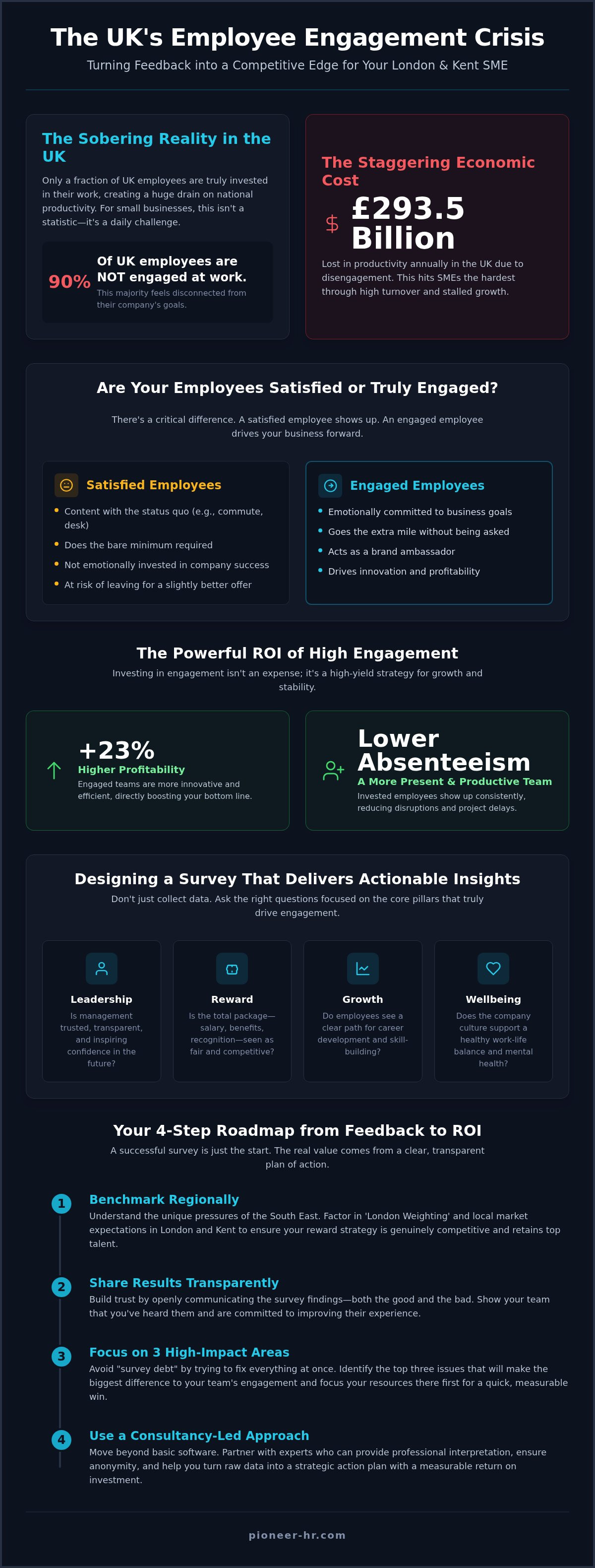
Collecting data is only the first half of the journey. The real value of employee engagement surveys uk businesses conduct lies in the transition from raw feedback to a structured action plan. We've seen too many SMEs fall into the trap of "analysis paralysis," where they spend months debating the numbers but never actually change the employee experience. To avoid this, we recommend a lean, transparent roadmap that focuses on momentum rather than perfection. By following a clear sequence of steps, you can ensure that your team feels heard and that your investment in their feedback yields a tangible return on investment.
Step 1: The "Town Hall". Transparency is the foundation of trust. We suggest sharing the results, both the good and the bad, with the entire company shortly after the survey closes. This isn't about defending your position; it's about acknowledging the current reality.
Step 2: Prioritisation. Don't try to fix everything at once. Choose three key areas to focus on for the next six months. Whether it's improving internal communication or refining your reward strategy, a focused approach is far more effective than a scattered one.
Step 3: Manager Empowerment. Change happens at the team level. Give your supervisors the specific data and tools they need to address issues within their own departments.
Step 4: Continuous Listening. Implement shorter pulse surveys every quarter to track your progress. This allows you to see if your changes are actually working and lets you pivot quickly if they aren't.
The Role of Leadership Coaching
Engagement strategies often stall at the middle management layer because these individuals are expected to drive change without always having the necessary skills. We use survey data to pinpoint specific gaps in management training, ensuring that your leaders are equipped to handle difficult conversations and provide meaningful recognition. The quality of the daily connection between a manager and their team is the most significant factor in determining whether an employee chooses to stay or seek a new role within the competitive London market. By investing in your managers, you're directly protecting your most valuable assets.
Strategic Implementation with a Fractional CPO
For many SMEs, the challenge isn't a lack of desire to change, but a lack of time. This is where a fractional Chief People Officer can provide the bridge between data and results. We work with you to turn your survey findings into a comprehensive 12-month people plan that professionalises your culture while maintaining that vital "SME feel." We focus on KPIs that matter to your Board, such as reducing turnover rates and increasing eNPS scores, ensuring that every cultural improvement is backed by business logic. If you're ready to transform your feedback into a high-performance culture, our fractional Chief People Officer service offers the senior expertise needed to lead this transition.
Why a Consultancy-Led Approach Beats Software-Only Surveys
Many SMEs invest in automated platforms thinking they’ve solved their culture problems, but software is merely a tool, not a strategy. While many platforms offer automated employee engagement surveys uk businesses often find that software alone creates what we call "survey debt." This happens when you collect vast amounts of data but lack the senior HR capacity to interpret the nuances or implement meaningful changes. When employees share their honest thoughts and see no visible action, their engagement actually drops lower than if you’d never asked at all. We believe that a human expert is essential to explain the "why" behind the numbers, especially when dealing with the complex people dynamics of a growing team.
Our approach at Pioneer HR integrates these insights with a broader HR audit to give you a 360-degree view of your organisational health. We don't just look at the survey scores in isolation. Instead, we connect them to your existing policies, leadership styles, and reward structures. With over 30 years of strategic experience across London and the South East, we’ve seen how local market pressures influence results. We help you distinguish between a temporary dip in morale caused by external factors and a deep-seated cultural issue that requires a shift in management behaviour. This level of professional interpretation is something an algorithm simply cannot provide.
Bespoke vs. Off-the-Shelf
Your company has a unique DNA. A creative agency in Brighton shouldn't be using the same questions as a traditional manufacturing firm in Kent. Off-the-shelf surveys often miss the specific drivers that matter to your staff, such as your particular approach to hybrid work or your unique company values. We move away from generic data collection toward a strategic partnership. We help you design questions that reflect your mission, ensuring the feedback you receive is directly relevant to your future growth. This tailored approach ensures that your employee engagement surveys uk results lead to specific, high-impact actions rather than vague corporate platitudes.
Ready to Transform Your Workplace?
Starting your engagement journey with us is a structured, supportive process. In the first 90 days, you can expect a rapid transition from uncertainty to clarity. During the first month, we focus on bespoke survey design and launch. By the second month, we’re deep into analysis and hosting your results "Town Hall." By day 90, we’ve worked with your leadership team to establish a prioritised action plan and begun the manager empowerment sessions needed to drive change. We’re here to ensure your people strategy is as robust as your business plan. If you’re ready to build a culture that attracts and retains the best talent in the South East, book an engagement consultation with Pioneer HR today.
Building a Culture That Lasts Beyond 2026
We've explored how employee engagement surveys uk businesses use can move from simple data collection to a powerful driver of retention and growth. By acknowledging the unique pressures of the London and South East markets and prioritising actionable steps over generic templates, you're already ahead of the curve. It's clear that the bridge between hearing your team and seeing measurable ROI lies in strategic interpretation and a commitment to transparency.
Our team brings over 30 years of HR leadership experience to the table, specialising in bespoke reward and engagement strategies for UK SMEs. We understand the specific cultural nuances of firms in Kent, Sussex, and London; this allows us to provide insights that software alone simply can't reach. Every organisation has its own story, and we're dedicated to helping you write the next chapter through professional, partnership-led support that values the human element as much as the data.
Explore our Employee Engagement and Reward services to start your journey toward a higher-performing workplace today. You don't have to navigate these cultural shifts alone; together, we can build a culture that your people truly value and a business that thrives.
Frequently Asked Questions
What is a good employee engagement score for a UK SME?
A good score depends on the metric used, but for the Employee Net Promoter Score (eNPS), anything above 0 is technically positive. In the UK SME sector, a score between 10 and 30 is considered good. Since the current UK median eNPS is 5, achieving a score of 15 or 20 puts your business ahead of many regional competitors. We always look at the trend over time rather than just a single snapshot.
How often should we run employee engagement surveys?
We recommend a hybrid approach with one comprehensive annual survey supplemented by quarterly pulse checks. This structure allows you to establish a robust baseline while remaining agile enough to track the impact of specific changes. Running employee engagement surveys uk too often can lead to survey fatigue, but waiting a full year between check-ins might mean you miss critical shifts in team morale or market conditions.
Are employee engagement surveys truly anonymous?
Surveys are only truly anonymous when managed by an independent third-party partner. Employees are often hesitant to be completely honest if they suspect their responses can be traced back to them by internal IT or HR teams. We ensure that individual data is never shared; we only provide aggregated reports for groups large enough to protect every participant's identity. This independence is vital for gathering the unfiltered truth.
How do I encourage employees to participate in the survey?
The best way to drive participation is to prove that feedback leads to real action. If your team sees that previous surveys resulted in a better reward strategy or improved management training, they'll be far more likely to engage. We suggest clearly communicating the "why" before the launch and promising a specific date for sharing the results. Transparency throughout the process shows that we value their time and their opinions.
What is the difference between an engagement survey and a pulse survey?
An engagement survey is a deep dive into your entire culture, while a pulse survey is a brief "temperature check" on a specific topic. The annual survey covers broad pillars like leadership, growth, and wellbeing. In contrast, a pulse survey might only have three questions focused on a recent change, such as a new hybrid policy in your Kent office. Using both ensures you have both depth and agility in your strategy.
How much does a professional employee engagement survey cost in the UK?
Costs for employee engagement surveys uk vary significantly based on your headcount and the depth of consultancy required. While basic software tools can be inexpensive, they lack the expert analysis needed to drive change. For context, some fixed-price sector surveys in the UK cost around £2,400 for non-members, but bespoke SME solutions are priced based on the complexity of the project. We focus on providing a solution that delivers a clear return on investment.
Can an engagement survey help reduce staff turnover in London?
Yes, because it identifies the specific "push" factors that drive people toward the exit before they actually resign. In the competitive London job market, knowing if your team feels underpaid compared to local benchmarks or if they feel a lack of career progression is essential. This data allows you to make targeted interventions, such as adjusting your reward strategy, which directly protects your business from the high cost of constant recruitment.
What should I do if my survey results are negative?
Negative results should be treated as a strategic diagnostic tool rather than a sign of failure. The most important step is to acknowledge the feedback openly with your team rather than ignoring it. We help you break down the data to find the root causes and develop a prioritised roadmap for improvement. Facing the "brutal facts" honestly is often the most powerful way to begin rebuilding trust and improving your company culture.


Comments