
How to Benchmark Salaries for Remote Roles in the UK
A salary range is only as reliable as the roles behind it. Compare a London hybrid position with a fully remote role in Kent, or rely on job titles alone, and credible-looking market data can still lead to an unfair result.
If you’re asking “how to benchmark salaries for remote roles uk?”, start with a concern many employers share: salary surveys and job adverts don’t always distinguish clearly between remote, hybrid and office-based work. Location adds another decision, especially when you’re weighing London rates, regional rates or one UK-wide scale.
A fair benchmark starts with equivalent work, then treats geography as an explicit policy choice. This guide explains how to compare role scope and responsibilities, assess relevant UK market data and account for salary alongside the wider reward package.
It also covers building consistent salary ranges, explaining pay decisions and reviewing your approach over time. Pioneer HR’s salary benchmarking brings together market-data analysis and comparisons with internal pay, giving organisations a clearer evidence base for decisions that reflect their needs.
Table of Contents
What makes a salary benchmark relevant to a UK remote role?
A useful benchmark compares equivalent work with relevant external pay evidence. It should reflect the role’s accountabilities, required skills and working arrangement, rather than treating “remote” as a separate job level. Remote describes where work is done. It doesn’t, by itself, indicate responsibility, seniority or value.
Remote-role benchmarking compares a role’s duties and scope with external pay evidence for genuinely similar work, taking account of how and where the role is performed. This is a sounder starting point than matching job titles alone. It also makes the limits of the evidence clearer: a market comparison informs a pay decision, but doesn’t determine the organisation’s salary range on its own.
Before selecting data, distinguish fully remote roles from hybrid positions and jobs tied to a workplace. A hybrid role may involve regular attendance at a London office, while a fully remote role may have no routine workplace attendance. The arrangements can attract different candidate markets or expectations, so combining them without noting the distinction may weaken the comparison.
What counts as a genuinely comparable remote role?
Compare the substance of the work: core responsibilities, decision-making authority, required skills and experience, and expected impact. Then record whether the role is fully remote, hybrid or workplace-based, including any regular location requirement. Two roles with the same title can differ substantially. One “People Manager” might lead a team and shape policy, while another handles a narrower operational remit.
Write a short role profile before looking at salary figures. Note the role’s purpose, key accountabilities, reporting line, scope of decisions and essential expertise. This reduces the risk of selecting a high or low comparator simply because its title sounds familiar. If duties only partly overlap, record the gap rather than treating the roles as interchangeable.
Which pay components belong in the comparison?
Keep base salary distinct from variable pay, allowances and employer-provided benefits. A figure for basic annual pay can’t be compared directly with total reward that includes a bonus or other benefits. Before combining evidence, define which components are included and use the same basis across the roles being assessed.
Label what each source measures. An advertised salary range shows what an employer is offering for a vacancy; reported pay reflects salaries submitted or recorded for employees; employer data may describe actual pay within a particular organisation. These sources are useful for different purposes, but they aren’t equivalent observations. Record the source, date and definition alongside each figure so the reasoning remains clear when you revisit it.
A practical answer to how to benchmark salaries for remote roles uk starts with disciplined role matching and transparent data definitions. If your team needs help comparing roles or interpreting inconsistent evidence, tailored salary benchmarking can provide market-data analysis and reports comparing internal pay with industry standards.
How to select and assess salary data for remote roles
Once you’ve defined the role, decide which evidence is relevant and how much weight it deserves. A salary figure without context can look precise while describing a different role, location or type of pay. Use a consistent process so another decision-maker can follow how you reached the proposed comparison.
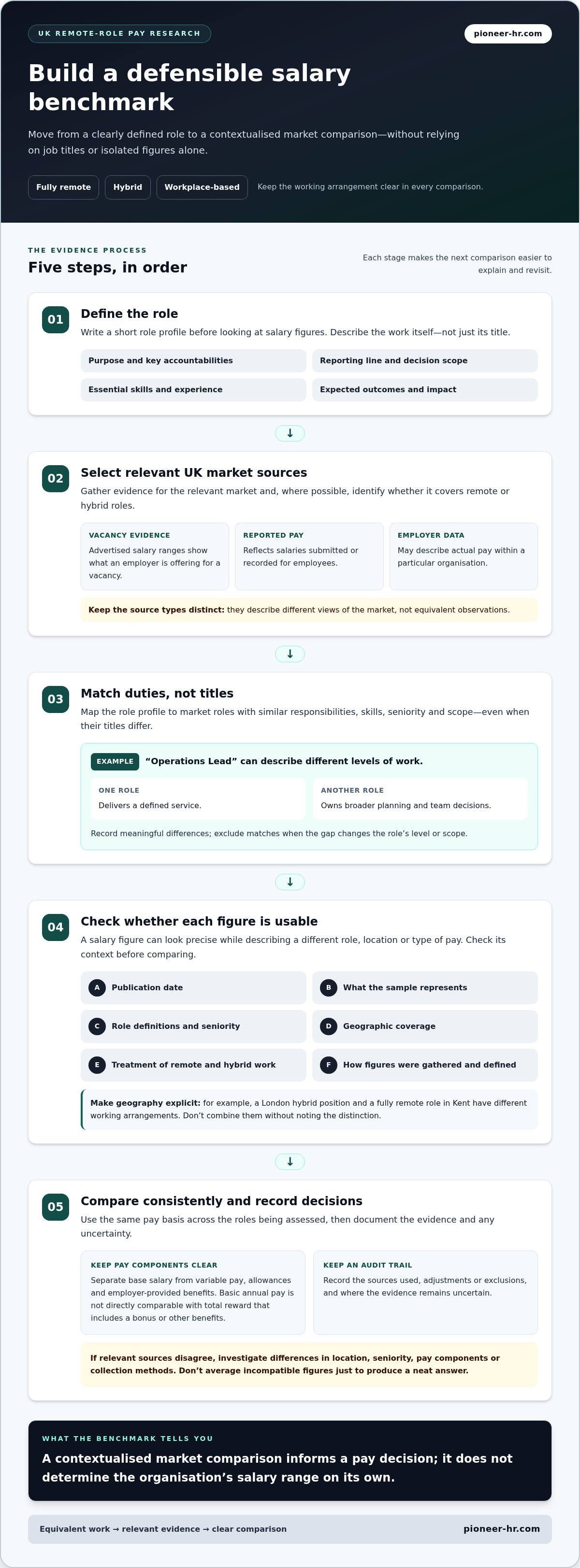
Work through these steps in order:
Define the role: Summarise its scope, key outcomes, skills, seniority and working arrangement.
Select sources: Gather salary evidence covering the relevant UK market and, where possible, identifying remote or hybrid roles.
Match duties: Compare the work and level of responsibility, not just the title.
Compare figures: Check each figure’s definition and pay components before setting it alongside another.
Record decisions: Note the sources used, any adjustments or exclusions, and where the evidence remains uncertain.
How should employers match roles when titles differ?
Start with a concise role profile covering responsibilities, expected outcomes, skills and seniority. Use it to map the work to market roles, even if their titles differ. For example, an “Operations Lead” might deliver a defined service, while a similarly titled role elsewhere owns broader planning and team decisions. Record those differences and exclude matches where the gap changes the role’s level or scope.
How can employers judge whether salary data is usable?
Check when the information was published, what its sample represents, which geography it covers and how the source gathered or defined its figures. See whether remote work is identified or whether the data combines fully remote, hybrid and office-based roles. Keep advertised salaries separate from employee-reported pay and employer-submitted figures, as each describes a different view of the market.
Compare more than one relevant source when the role definitions and coverage allow a fair comparison. If sources disagree, investigate whether they reflect different locations, seniority levels, pay components or collection methods. Don’t average incompatible figures just to produce a neat answer. A contextualised range is usually more informative than a single figure, which can conceal variation in role match, source method and market coverage.
Keep a short evidence log beside the figures. For each source, record its date, geography, role description, pay definition and any limits on its use. Mark gaps or conflicting comparisons clearly rather than implying a level of precision the data can’t support. This makes the reasoning easier to explain and revisit when roles or market evidence change.
A practical approach to how to benchmark salaries for remote roles uk treats data as evidence to assess, not an answer to copy. When role matching or inconsistent sources make that assessment difficult, tailored salary benchmarking can help create a clearer comparison of internal pay with industry standards.
Should UK remote salaries vary by employee location?
There’s no single location policy that suits every UK employer. A nationally consistent band can make pay easier to explain across a remote team, while location-sensitive bands may reflect differences in the markets an organisation chooses to compete in. Make the choice deliberately, then apply it consistently.
Observed geographic pay differences describe market data; an employer’s location policy is a separate decision about how it chooses to set pay. A reported difference between London and other parts of the UK doesn’t automatically justify an adjustment to your salary bands. First understand what the data measures, then decide whether location should influence your policy.
What are the trade-offs between national and location-based pay?
Use this comparison to identify which model better fits your organisation’s priorities. Neither approach is automatically fairer; fairness depends on clear reasoning and consistent application.
Nationally consistent bandsOne band applies to equivalent roles across the UK, regardless of an employee’s home location. This can support consistency and make ranges simpler to administer and explain, but may not reflect every market your organisation recruits in.
Location-sensitive bandsPay ranges vary according to defined geographic areas. This can reflect chosen recruitment markets, but requires clear rules about which locations count, how boundaries are set and how the approach is maintained as teams and markets change.
Consider the practical implications before choosing. Would colleagues doing equivalent work understand why their pay bands differ, or why they don’t? Can managers apply the policy consistently when an employee moves, a role changes or recruitment spans several regions? Clear answers connect the model to internal equity, recruitment needs and employee understanding.
How should London and Kent feature in the comparison?
Use London and Kent as locations to test your evidence, not as automatic pay categories. Check whether each source separates London from broader UK or regional figures, and note how it defines those areas. A source that groups several locations together may not support a precise comparison between a London-based employee and someone working remotely from Kent.
Don’t apply a London premium or Kent adjustment without relevant evidence and a policy reason. If your data shows a difference, consider whether it reflects comparable roles, similar pay components and the same kind of employment arrangement. Where the evidence is too broad to support a location-specific conclusion, record that limitation rather than treating an assumed regional rate as fact.
Document the location definition your organisation will use, such as the employee’s work location or a defined recruitment market, and explain why it fits your approach. Apply the definition consistently to comparable roles and make clear how exceptions will be handled. This is particularly useful for remote teams, where employees may work far from an office or across multiple UK regions.
A considered approach to how to benchmark salaries for remote roles uk links market evidence to a transparent pay policy. The policy should explain whether geography informs the band, how it is defined and when the organisation will review that decision.
How to turn remote salary research into a fair pay range
Validated market comparisons provide an evidence base, not a finished salary band. To turn them into a proposed range, consider what the external data says alongside your organisation’s internal structure, affordability and reward priorities. Keeping these inputs distinct helps show whether a decision reflects the market, an internal principle or a practical constraint.
Group the strongest comparable evidence and review its spread. Where role matches and data definitions are consistent, the pattern can help inform the range’s lower and upper points. If the evidence is limited or sources disagree, avoid implying more certainty than the data supports. A range should reflect the quality of the evidence, not the number of decimal places in a spreadsheet.
How do employers build a range without false precision?
Set out how someone’s position within the range will be assessed. For example, consider how closely their skills and experience meet the role requirements, alongside their contribution in the role. Apply those criteria consistently rather than using a person’s location or negotiating history as an informal substitute. Keep incomplete evidence and unresolved differences visible in the rationale.
Test the proposed range against your existing pay structure. Consider whether it creates unintended overlap with related roles or inconsistencies between comparable levels. Separately assess affordability and wider reward choices, such as the balance between base salary and other package elements. These are organisational decisions informed by the benchmark, not market facts that the benchmark itself can settle.
A compact decision record can make the reasoning easier to review. Include:
Role match: the matched market role and any differences in scope.
Source and geography: where the evidence came from and which market it covers.
Comparison: the pay information used, with its definition and relevant limitations.
Decision rationale: how the evidence, internal structure and affordability informed the proposed range.
How should employers explain and review the decision?
Prepare a concise explanation connecting the role’s scope to the evidence and the organisation’s chosen pay approach. Record assumptions, exceptions, who approved the range and when it should be reviewed. Set a review point around organisational needs, such as a material role change or new market evidence, rather than relying on an unexplained routine adjustment.
This creates an audit trail for future decisions and helps managers explain the range consistently. It also lets the organisation revisit an assumption when circumstances change without treating every new data point as an automatic reason to alter pay.
Salary Benchmarking UK: A Strategic Guide for Employers in 2026 provides wider context for using salary evidence as part of a considered pay approach. For support turning market comparisons into a clear evidence base, explore tailored salary benchmarking.
When tailored salary benchmarking can help with remote roles
Some benchmarking decisions are straightforward. Others become harder when roles combine different responsibilities, market sources use inconsistent definitions, or internal pay has developed without a clear structure. In these situations, an external perspective can help organise the evidence and show where comparisons are strong, partial or uncertain.
This can be useful for specialist or blended roles, where a single market title may not capture the full remit. A remote position might also sit within a team whose pay bands were designed around office-based roles or one location. Rather than force a simple match, a tailored review can make the reasoning behind the comparison more visible.
What can a tailored review bring together?
Pioneer HR’s project-based salary benchmarking uses market-data analysis and reports comparing internal salaries with industry standards. The work is tailored to the organisation and project, bringing role scope and available external evidence into the same review. Internal salary information can be considered alongside relevant market comparisons, so the findings inform pay decisions without automatically dictating them.
If the question extends beyond market alignment, consider the findings in the context of a broader reward strategy. This can help when an organisation needs to weigh salary ranges alongside its wider approach to reward, rather than treating a market figure as the only factor. Our reward consultancy can provide that broader context where it’s relevant.
What should employers have ready for a benchmarking discussion?
A clear starting point helps keep a review focused. Gather the material that describes both the roles and the decisions you need to make, including:
Current role profiles: responsibilities, scope, required skills and expected outcomes.
Internal pay information: existing salary structures and the roles or levels you want to compare.
Working arrangements: whether roles are fully remote, hybrid or tied to a workplace.
Geographic pay approach: how your organisation treats location, including how it defines relevant markets such as London, Kent or the wider UK.
Key questions: the decisions the review should inform, such as whether role matches are suitable or existing ranges need reconsideration.
Identify where your current evidence conflicts or leaves gaps. That gives the discussion a practical focus and helps distinguish what the data can support from what still requires an organisational decision. A considered process for how to benchmark salaries for remote roles uk brings role comparisons, market evidence and internal context together without presenting the outcome as automatic.
If your team would value a structured review, explore salary benchmarking support for a tailored assessment of your organisation’s roles and pay evidence.
Make your next pay decision with confidence
A well-considered pay policy should remain useful as roles evolve and your organisation’s priorities shift. Treat each benchmark as a point-in-time evidence base, then set a clear point to revisit its assumptions. That gives your team room to respond to changing responsibilities or market evidence without making pay decisions reactively.
Putting how to benchmark salaries for remote roles uk into practice means making choices your organisation can explain and apply consistently. If role comparisons are complex or the evidence is difficult to reconcile, an independent perspective can help clarify what the data supports and where further judgement is needed.
Pioneer HR brings over 30 years of HR experience to its work with organisations. Discuss a tailored salary benchmarking review to explore an approach suited to your roles and questions. A clear rationale behind your decisions can help you build a pay approach that supports your organisation and its people.
Frequently Asked Questions
How often should a UK employer review salary benchmarks for remote roles?
Review them when it makes sense for your organisation and the roles involved, rather than following a universal timetable. Set a review point and record the date and evidence used, then bring it forward if a role’s responsibilities change, recruitment becomes difficult or new internal pay questions arise. For example, a hard-to-fill remote vacancy may prompt an earlier check of the relevant market. A review informs decisions; it doesn’t automatically require a pay adjustment.
Can employers use online job adverts to benchmark remote salaries?
Yes, adverts can offer useful context, particularly when they include a salary range and enough detail about the role. Treat them as evidence of an advertised offer, not proof of the salary ultimately agreed or the full reward package. Note the advert date, location expectations, responsibilities and experience level. If an advert gives a broad range but little role detail, use it cautiously and compare it with other relevant evidence before drawing conclusions.
What should an employer do when a remote role has no exact market match?
Build a comparison from the role’s main accountabilities rather than waiting for an identical title. For a blended role, identify its distinct areas of responsibility and find the closest market matches for each. Then consider which accountabilities define the role’s level, rather than mechanically averaging unrelated figures. Explain where the matches differ and how that affects your confidence in the comparison. If evidence is weak, avoid presenting a precise market figure as definitive.
Should remote-role salary benchmarks include benefits?
Include benefits only when you’re deliberately comparing total reward and the available data describes those elements clearly. For instance, an advert showing base salary alone shouldn’t be compared directly with a figure that combines salary, variable pay and benefits. Keep separate records for base pay and other reward components, and state what each comparison includes. This lets decision-makers see whether an apparent difference comes from salary or the wider package.
Does a remote employee’s home address determine their salary?
No, not automatically. An employer can choose a UK-wide approach or one that takes location into account, then set clear rules for applying it. Consider what happens if someone moves from London to Kent, or if their home location changes but their role and responsibilities don’t. Defining whether a move prompts a review helps avoid inconsistent decisions. Explain the policy to employees and review its reasoning as organisational needs evolve.
How can a small UK business benchmark remote-role salaries with limited internal data?
Start with the information you do have: clear role profiles, current salaries and the questions behind the review. For a small team, internal comparisons may be limited, so make external evidence do more of the work while noting its scope and limitations. Focus first on roles where hiring or retention decisions make pay clarity especially useful. This is central to how to benchmark salaries for remote roles uk without implying more certainty than the evidence supports.
What is the difference between benchmarking a remote role and setting its salary?
Benchmarking establishes how a role compares with relevant external pay evidence; setting salary is the organisation’s decision about how to use that information. For example, a market comparison may inform the proposed band for a role, while its final range also reflects internal levels and the organisation’s reward approach. Keeping these steps separate makes it easier to explain the evidence behind a decision without suggesting the market figure dictates the outcome.



Comments