
Employee Offboarding UK: A Practical Guide for Employers
A colleague’s final day can arrive with handover notes unfinished, system access still active and practical tasks unclear. The departure may be expected, but the work of managing it shouldn’t be left to chance. A clear employee offboarding process UK employers can follow helps make the transition more manageable.
Employers need to protect business continuity and information while treating departing colleagues with care. A consistent process gives everyone clarity about what needs to happen and who is responsible, while leaving room to adapt steps to the circumstances.
This guide sets out a practical sequence for the period before, on and after an employee’s final day. It covers how managers, HR and operational colleagues can coordinate communication, knowledge transfer, company property and access, final administration and feedback. Whether your team is based in London, Kent or elsewhere in the UK, a thoughtful approach can make departures more orderly without treating every situation as identical.
Table of Contents
What an employee offboarding process in the UK should achieve
The employee offboarding process: a practical sequence from notice to follow-up
Resignation, dismissal or redundancy: adapt the process without losing consistency
Employee offboarding checklist: handover, access, records and communication
Improve your employee offboarding process with ongoing HR support
What an employee offboarding process in the UK should achieve
Employee offboarding is the planned process of managing someone’s departure and its practical consequences for the person, the organisation and its records. It has three main aims: support people, maintain operations and handle records consistently. That means more than recording a leaving date. Employers need to plan how work will continue, who needs to know what and how to close out responsibilities clearly and considerately.
A resignation is initiated by the employee, while a dismissal or redundancy is employer-led. Communication, timing and handover needs will differ, so adapt the process rather than applying it mechanically. A useful Employee Offboarding overview offers wider context, but your process should reflect your organisation’s roles, working arrangements and the circumstances of each departure.
Why a consistent process matters for UK employers
A consistent framework helps prevent practical details from being overlooked, particularly when a departure involves several people or teams. For example, when a manager knows who will document key project knowledge and who will tell colleagues about changes in responsibilities, the team is less likely to be left guessing after the employee leaves. Consistency also supports fair treatment while allowing a tailored approach where circumstances call for one.
Small employers benefit too. A business in London, Kent or elsewhere in the UK may not have a dedicated HR department, but it can still agree who coordinates each departure. The process should be simple enough to follow, with clear owners for tasks such as handover, property and access, and flexible enough to suit different situations.
Who should take responsibility for each part
Responsibility can be shared without becoming unclear. The line manager can coordinate the work handover and team communication. HR, where available, can help organise people processes and records. Operational colleagues can manage tasks in their areas, such as systems access or company property, while the payroll contact handles relevant departure information.
Give one named person responsibility for tracking completion. That person doesn’t need to complete every task or belong to an HR team. In a small business, it might be the owner or a manager; in a larger organisation, it could be an HR lead. Record each task’s owner, any required approval and how completion will be noted. Retained HR support can help SMEs establish and review people processes as their needs change.
The employee offboarding process: a practical sequence from notice to follow-up
A practical employee offboarding process should show what happens at each stage, who owns it and how completion is recorded. Use the sequence below as a starting point, not a fixed template. Adjust it to the reason for departure, the role and your organisation’s structure. Dates, payroll arrangements and applicable requirements can vary, so verify current UK guidance before relying on specific requirements.
From notification to the employee’s final working day
Start by agreeing who will coordinate the process. That person can track actions across the manager, HR and operational colleagues, even if a small employer has no dedicated HR team. Keep the employee informed about relevant arrangements, and agree how and when colleagues will be told.
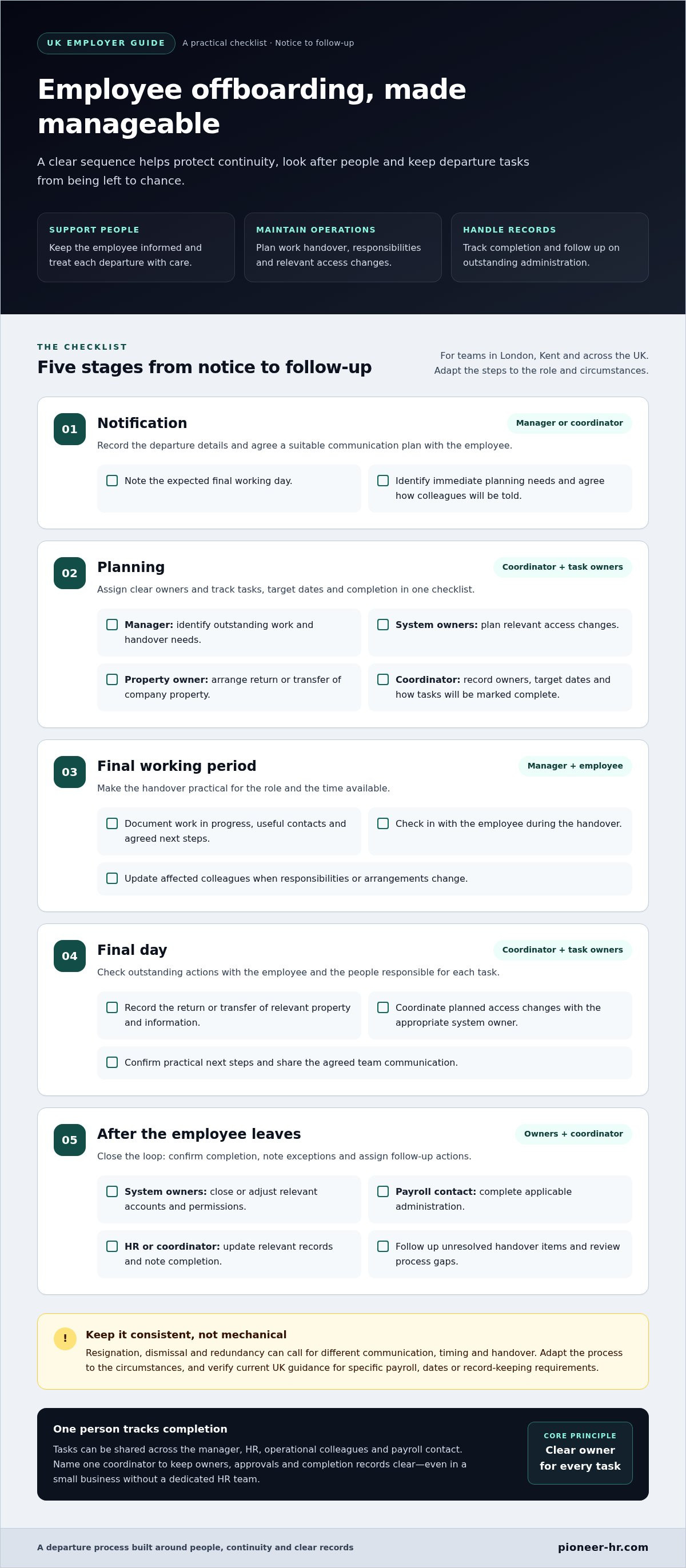
Notification. The manager or designated coordinator records the departure details, including the expected final working day and any immediate planning needs. Record the confirmation in the appropriate place, then agree a suitable communication plan with the employee.
Planning. The coordinator assigns tasks to the relevant owners. The manager identifies outstanding work and handover needs; system owners plan any access changes; and the person responsible for company property arranges its return or transfer. Use a checklist to record owners, target dates and completion.
Final working period. The manager and employee work through the handover in a way that reflects the role and time available. Document key work in progress, useful contacts and agreed next steps. Check in with the employee, and update affected colleagues when responsibilities or arrangements change.
Final day. The coordinator checks outstanding actions with the employee and task owners. Record the return or transfer of relevant property and information, and coordinate planned access changes with the appropriate system owner. Confirm practical next steps and share the agreed team communication.
What to complete after the employee leaves
Close the loop rather than assuming final-day tasks resolved everything. The coordinator should confirm completion with the relevant owners, note any exceptions and follow up on unresolved handover items.
Follow-up. System owners close or adjust relevant accounts and permissions, while the appropriate payroll contact completes applicable administration. HR or the coordinator updates relevant records and notes completion. Check current UK requirements for specific record-keeping or payroll steps, then review gaps and assign follow-up actions.
For SMEs that want help maintaining a consistent process as the organisation changes, retained HR support provides ongoing practical input to people processes.
Resignation, dismissal or redundancy: adapt the process without losing consistency
The same administrative framework can support different departures, but communication, timing and handover should reflect the circumstances. A checklist can track routine actions, but it can’t resolve a sensitive or disputed situation on its own. Use your documented process as a structure, then consider whether the individual case calls for a more careful approach.
For every type of departure, assign an owner to track agreed tasks and keep a record of completion. The controls can stay consistent while the details change. A long handover may suit one resignation, for example, while another departure may call for a more limited transfer of work.
What changes when an employee resigns
Start by acknowledging the resignation and confirming relevant dates and next steps through the appropriate channels. Give the employee a clear point of contact, then agree how outstanding work, key knowledge and communications will be managed. An exit conversation can invite feedback about the employee’s experience and possible improvements, but participation should be respectful and pressure-free. Some employees may prefer not to take part.
How to handle employer-led departures with care
Redundancy and dismissal call for careful coordination and communication tailored to the situation. A standard checklist can prompt operational actions, but it doesn’t replace appropriate consideration of the circumstances, approvals or employee communications. This guide doesn’t set out disciplinary or redundancy procedures; check current authoritative UK guidance for case-specific requirements before taking action. Where the circumstances are sensitive or disputed, don’t rely on routine offboarding steps alone.
Employee offboarding checklist: handover, access, records and communication
A useful checklist makes ownership visible, not just tasks. Keep core controls consistent while marking role-specific actions as applicable. For example, an employee who manages key client work may need a detailed handover, while a role without specialist system access may not need the same systems review.
Plan handover and business continuity
Agree who will take ownership of ongoing work before the employee leaves. The handover should be useful to colleagues, not just a folder of notes without context. Consider recording priority tasks, key contacts, upcoming deadlines, current decisions and where relevant information is stored. If responsibilities are changing, tell affected colleagues who to approach in the interim.
Line manager: Identify work in progress, deadlines, key relationships and a new owner for each priority. Agree what knowledge transfer is needed and record completion.
HR or the process coordinator: Track the checklist, confirm relevant internal communications and note any actions that remain open. In a small organisation, this role may sit with a manager or business owner.
Employee and manager: Agree the handover format and review whether it gives the next owner enough context to continue the work.
Close access and manage records responsibly
Coordinate access changes with the relevant IT or systems owner, taking account of the employee’s role, planned departure arrangements and business needs. Record which permissions or accounts have been reviewed and who completed each action. Don’t assume every account change should happen at the same time: access responsibilities and timing can differ between roles and circumstances.
IT or systems owner: Review relevant accounts, permissions and shared resources. Record changes and check ownership of business-critical files or services.
Line manager or property owner: Track the return or transfer of company property, such as a device, keys or access pass where applicable. Record what was received and any agreed follow-up.
HR: Update relevant employee records and store departure documentation in line with organisational policy.
Payroll contact, where applicable: Confirm that departure-related information has been passed through the organisation’s payroll process and record the action.
Handle personal data in line with organisational policies and current UK data protection requirements. The UK GDPR and the Information Commissioner’s Office (ICO) are relevant reference points. Check current ICO guidance for detailed questions about retention or access, rather than assuming a checklist alone settles them.
If your SME needs support maintaining consistent people processes, explore Pioneer HR’s retained HR support.
Improve your employee offboarding process with ongoing HR support
A documented process works best when it keeps pace with the organisation. After a departure, review whether responsibilities were clear, handover information was useful and any actions were missed. If the same issue recurs, such as managers being unsure who updates records or arranges communications, refine the process and explain the change to everyone involved.
Review the process when roles, systems or team structures change too. A checklist created for a small team may need updating as responsibilities become more specialised. The aim isn’t to add steps for their own sake, but to keep the process practical, consistent and suited to the organisation’s current needs.
When an SME may benefit from external HR support
Some departures run smoothly with an organisation’s existing process. Recurring gaps, uncertainty among managers or inconsistent documentation may suggest the process needs attention. For a growing SME, ongoing HR advice can help turn lessons from individual departures into repeatable people practices, while allowing managers to respond appropriately to different circumstances.
Support can be particularly useful when responsibility is shared across a small team and no one clearly owns process updates. Reviewing templates, clarifying roles and helping managers understand the steps can make the approach easier to follow without turning every departure into a major project.
How Pioneer HR can support a more consistent process
Pioneer HR provides retained HR support and practical advice to employers seeking to establish and maintain consistent people processes. This can include reviewing how an existing approach works in practice, identifying gaps in documentation or ownership, and helping managers apply agreed processes as the organisation changes. Ongoing support helps keep day-to-day people management organised.
Founder Sarah-Jane brings over 30 years of industry experience, informing Pioneer HR’s practical and strategic support for employers. If your team would benefit from a considered review of its people processes, explore retained HR support.
Make your offboarding process consistent and considered
A clear employee offboarding process UK employers can adapt helps turn a departure into a managed transition rather than a last-minute list of tasks. Keep ownership visible, plan handovers and practical steps in good time, and adjust communication to the circumstances. The same framework can support resignations, redundancy, dismissal and retirement without assuming every departure needs an identical response.
Once the process is documented, review it after departures. Notice where managers need clearer guidance, whether important knowledge was transferred and what could be made easier for the next leaver. Thoughtful improvements can help protect continuity while ensuring departing colleagues are treated with care.
Pioneer HR provides retained HR support and practical advice to UK employers looking to maintain consistent people processes. Founder Sarah-Jane brings over 30 years of HR industry experience and a considered perspective on the challenges employers face as their teams evolve.
If you’d like support reviewing or strengthening your people processes, explore retained HR support. Start with one practical improvement.
Frequently Asked Questions
What is an employee offboarding process?
An employee offboarding process is the planned sequence of communications and practical tasks that takes place when someone leaves an organisation. It may cover handover, company property, system access, relevant records and follow-up. A consistent process UK employers can adapt helps coordinate these activities while treating the departing colleague respectfully. The steps should reflect the person’s role, the circumstances of their departure and current UK requirements.
What should an employee offboarding checklist include?
A useful checklist identifies who owns each task and how completion will be recorded. It can cover communications, work handover, company property, system access, relevant record updates and applicable payroll administration. For example, a manager might own the handover while a systems owner coordinates account changes. Keep the checklist adaptable: not every departure requires the same actions. Verify current UK requirements before adding specific legal or regulatory instructions.
How do you offboard an employee after they resign?
Start by acknowledging the resignation and clarifying the agreed departure arrangements, including the expected final working day. Then plan the handover, assign owners for priority work, coordinate company property and system access, and complete relevant administration. Offer a respectful exit conversation where appropriate, without making it a retention discussion by default. Record completed tasks, and check current UK guidance if the circumstances raise questions beyond routine process management.
What happens to an employee’s access on their last day?
Plan access arrangements with the relevant system owners, taking account of the employee’s role, responsibilities and departure circumstances. Consider business accounts, shared systems and physical access where applicable, but don’t assume every change should happen at the same time. Record who is responsible for each action and when it is completed. Follow your organisation’s policies and current data protection practices when managing access and related information.
Should every departing employee have an exit interview?
No. An exit interview may be useful, but it won’t suit or benefit every departure. It can invite feedback about the employee’s experience, working practices and reasons for leaving. Explain its purpose, keep the conversation respectful and don’t pressure someone to participate. Handle comments thoughtfully and in line with your organisation’s approach to confidentiality. Recurring themes may inform improvements, while individual feedback should be considered in context.
What is the difference between offboarding after resignation and dismissal?
Both situations need clear ownership for handover, company property, system access and relevant administration, but communication and coordination can differ. A resignation is initiated by the employee; dismissal is employer-led and may involve additional sensitivities. A general checklist can organise practical tasks, but it can’t replace situation-specific consideration. Check current authoritative UK guidance for requirements relevant to the circumstances, and don’t assume one approach will fit every departure.
How should a UK employer handle an employee’s personal data when they leave?
Manage employee information in line with your organisation’s policies and current UK data protection requirements. Review relevant access and records, and avoid retaining personal information without a clear organisational reason. The UK GDPR and the Information Commissioner’s Office (ICO) are useful reference points, but a generic checklist isn’t a substitute for checking detailed compliance requirements. Consult current ICO guidance when reviewing specific questions about access, handling or retention.



Comments